Abstract
Marketing has progressively moved from mass communication toward segmentation, targeting, personalization, automation, and artificial intelligence. The AI era now makes it possible to infer latent customer states from large volumes of behavioral data, generate personalized interactions at scale, and continuously optimize customer experiences. Yet a central problem remains: most marketing systems still treat the customer primarily as a target, a profile, or a conversion opportunity.
 {width=95%}
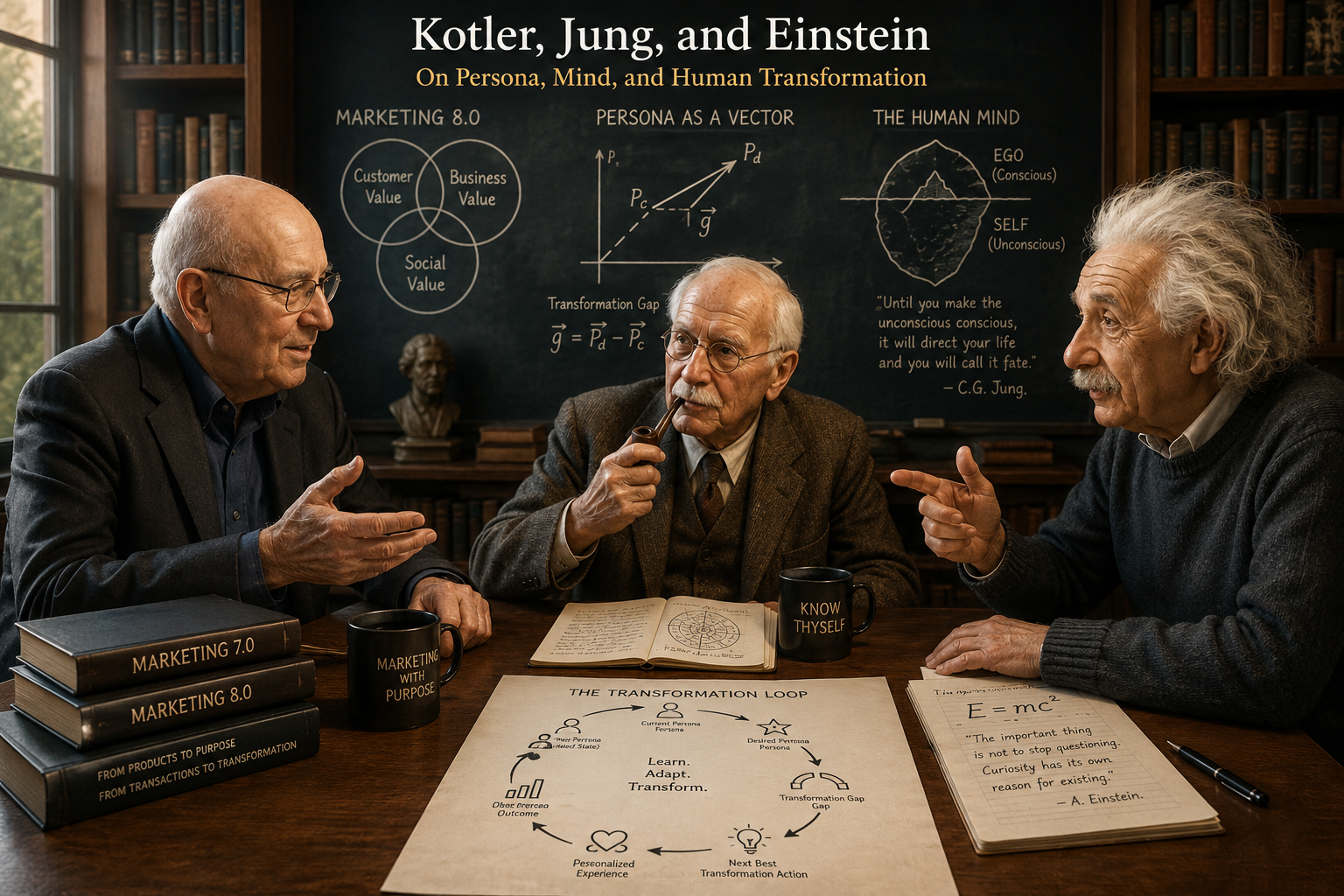
This paper proposes Persona as a Vector, an attractor-based theory for a more human-centric form of personalization. The framework models a customer’s current persona as a multidimensional state vector rather than a static label. A desired future identity is represented as a Desired Persona Vector. The difference between the two states defines a Transformation Gap. The desired state acts as a conceptual attractor: not a literal physical force, but a meaningful state toward which behavior, motivation, identity, and experience may evolve.
The framework integrates three AI capabilities. Deep Learning estimates a latent persona state from observable behavioral events. Persona Conversion Scoring measures the strength of behavioral signals associated with readiness for a desired action. Generative AI creates personalized content, recommendations, dialogue, offers, and experiences intended to support movement toward a desired state. The resulting system is a closed loop:
Three illustrative marketing applications are developed for retail banking, retail commerce, and gym and fitness services. The examples use synthetic sample data to demonstrate vector encoding, Persona Conversion Score calculation, calibration, next-best-action selection, and transformation measurement. The paper argues that the future of personalization should not optimize only for short-term conversion. It should optimize for the joint creation of customer value, business value, and social value, while preserving customer autonomy and transparency.
This framework is proposed as a conceptual contribution to the author’s Marketing 8.0 book. It extends the mind-centric direction associated with Marketing 7.0 toward a transformation-centric view of marketing in which products and services become instruments within a customer’s journey toward a desired state.
Keywords: Persona, Customer 360, Personalization, Deep Learning, Generative AI, Conversion Propensity, Customer Transformation, Attractor, Marketing 8.0, Customer Journey, Next Best Action
1. Introduction
Marketing has always been concerned with a basic question: why does a person choose one offering over another? Early mass marketing approached this question primarily through product, price, promotion, and distribution. Later approaches introduced segmentation, targeting, customer relationship management, digital behavior, and data-driven personalization. Contemporary AI systems extend this progression by predicting preferences, generating content, and optimizing interactions at individual scale.
Kotler, Kartajaya, and Setiawan’s Marketing 7.0: A Guide for Thinking Marketers in the Age of AI places explicit emphasis on a mind-centric view of marketing and on understanding how people think, connect, and buy in the AI era (Kotler et al., 2026). The present paper takes that direction one step further and asks a more fundamental question:
How can marketing understand not only what a customer is likely to buy, but who the customer is now, who the customer wants to become, and how a brand can responsibly support that transformation?
This question changes the unit of analysis.
Traditional segmentation remains useful, but static labels do not fully capture the fact that people change. Needs change. Intent changes. Values change. Context changes. Behavior changes. A customer who is currently inactive may aspire to become fit. A financially anxious customer may aspire to become financially confident. A novice shopper may aspire to become a knowledgeable and deliberate consumer.
Therefore, the central premise of this paper is:
The second premise concerns consumer choice itself. A purchase is often not the beginning of the process. It is frequently a consequence of an underlying state involving identity, aspiration, need, intent, and context.
This suggests a change in personalization logic. Rather than beginning with a product recommendation, a transformation-oriented system begins with the current persona and desired persona and asks which experience best supports the next step.
The proposed core logic is therefore:
Marketing 8.0, as used in this paper and the author’s book, is a proposed future-oriented framework, not a claim about an officially published Marketing 8.0 edition. Its distinctive premise is that AI should be used not only to improve prediction and conversion, but to support meaningful customer transformation.
2. Theoretical Foundations
2.1 Jung: Persona, Self, and Individuation
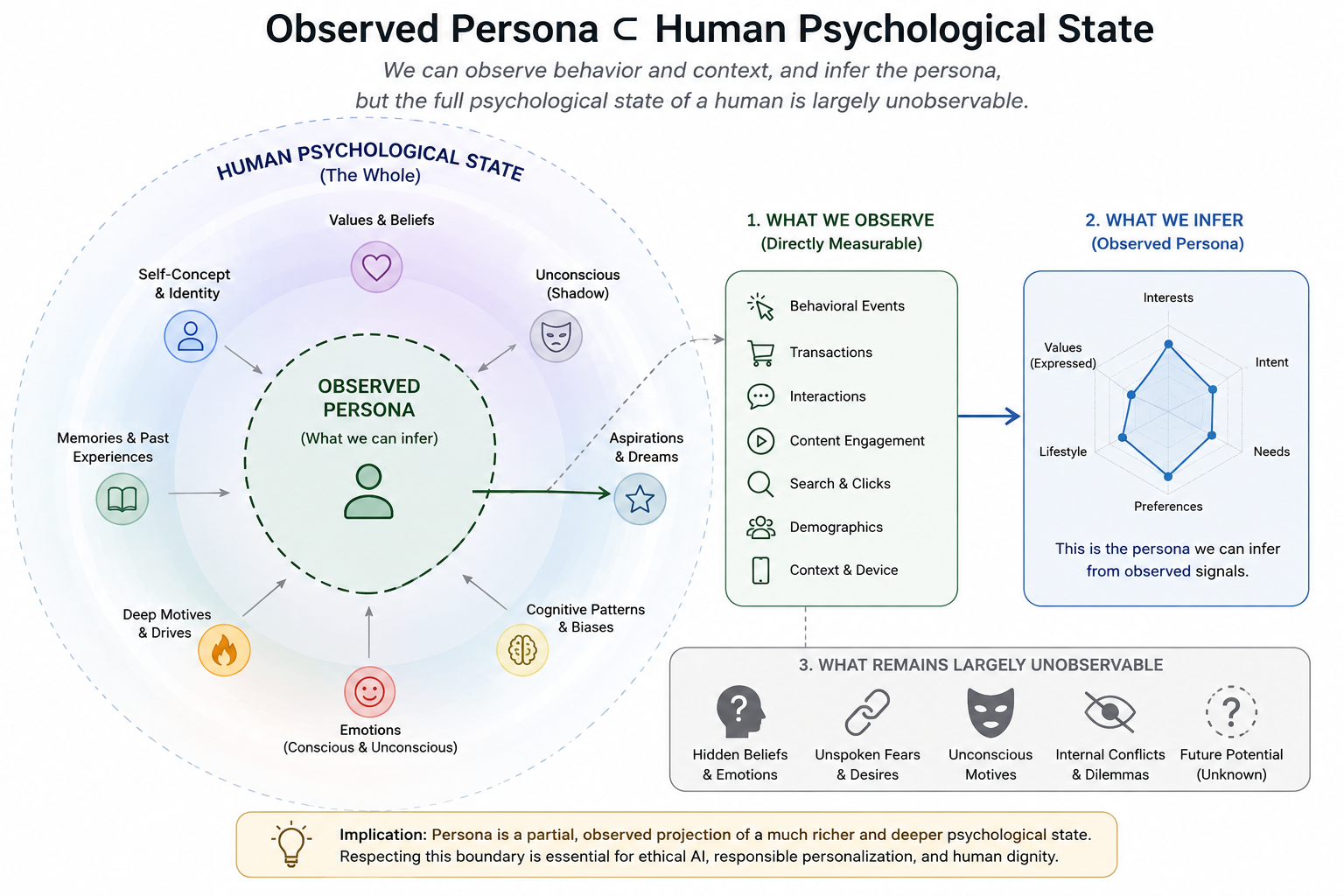
Carl Jung introduced the concept of the Persona as the social face through which an individual interacts with the external world. Jung’s Persona should not be equated with the entire human self. A person’s visible social identity is only one layer of a deeper psychological totality.
Jung’s broader concept of the Self refers to psychological wholeness, while individuation describes a developmental process through which conscious and unconscious aspects of personality become more integrated (Jung, 1959). The significance for marketing is conceptual rather than clinical: a customer-facing identity may be observed while the deeper structure that produces preferences, aspirations, and behavior remains only partially observable.
Thus:
 {width=95%}
A marketing system never observes the whole person. It observes traces: clicks, searches, purchases, conversations, location, content engagement, transactions, preferences, and declared information. Persona is therefore an inferred representation, not a complete description of the individual.
This leads to the first theoretical assumption:
A customer persona is an observable and modelable approximation of a deeper, continuously changing human state.
The framework intentionally avoids claiming that machine learning can recover the totality of a human being. Instead, the objective is practical: construct a useful state representation for better customer understanding and more responsible personalization.
2.2 Einstein: From Force to Field
Einstein’s General Theory of Relativity reframed gravity as a geometric relationship between matter-energy and spacetime rather than simply as a classical force acting at a distance (Einstein, 1915, 1916). This paper does not claim that human psychology follows General Relativity, nor does it attempt to turn Jungian psychology into physics.
Instead, Einstein provides a useful conceptual analogy: a system can be understood through states, trajectories, and fields rather than only through isolated objects and events.
In the present framework, a person is represented as a state in a multidimensional persona space, and a meaningful future identity is treated as a conceptual attractor.
This trajectory-based view provides the mathematical intuition for Persona as a Vector.
2.3 Consumer Choice as Consequence, Not Starting Point
Traditional marketing dashboards often begin with outcomes: impressions, clicks, conversions, transactions, revenue. These are essential business metrics, but they are downstream events.
A deeper behavioral chain can be expressed as:
The proposition is not deterministic. Not every aspiration becomes an intention, and not every intention becomes a purchase. Rather, purchase is often an observable consequence of an upstream state.
For marketing intelligence, this means the transaction is only one point in a much larger process. The deeper analytic question is not merely “What did the customer buy?” but “What state of the customer made this choice meaningful?“
3. Persona as a Dynamic State Vector
A customer’s persona should not be treated as a static label or a fixed demographic profile. It is better understood as a dynamic state that changes over time as the customer’s needs, intentions, emotions, behaviors, relationships, and circumstances evolve.
Let the customer’s current Persona State Vector be represented as:
where:
- = Values — principles, priorities, and beliefs that influence decisions;
- = Behavioral Patterns — observed and inferred patterns of action and engagement;
- = Needs — current problems, needs, motivations, and desired outcomes;
- = Intent — current goal-directed intention toward an action, product, service, or outcome;
- = Emotional State — the customer’s current affective state and its estimated influence on behavior;
- = Aspirations — desired future states, goals, and self-development directions;
- = Relational and Social Influence — the influence of family, peers, communities, social networks, influencers, and other relationships.
These dimensions are illustrative rather than exhaustive. A production system may use more dimensions, fewer dimensions, latent embeddings, or a hybrid representation combining interpretable features with learned representations.
3.1 Persona Is a Dynamic State
The defining property of the Persona State Vector is its temporal nature:
for many pairs of time points and .
In other words, persona is not a permanent attribute; it is a state that evolves over time.
A conventional customer segment might classify an individual as:
“Premium Customer, Age 35—44.”
Such a label provides useful but limited information. It represents only a coarse projection of the customer’s overall state.
A vectorized persona can represent a much richer and more dynamic state. For example, at a particular moment the same customer may exhibit:
- high product interest;
- medium purchase intent;
- high content engagement;
- low price confidence;
- strong aspiration toward financial security; and
- increasing influence from family recommendations.
The same individual may exhibit a substantially different state several weeks later as circumstances, experiences, or goals change.
Therefore, personalization should not be based solely on who the customer is, but also on where the customer currently is in their evolving state.
3.2 Context as an External State Variable
Although context strongly affects persona, it is conceptually useful to distinguish persona state from context.
Rather than treating context as a permanent component of the persona itself, we define:
Context may include:
- time and temporal conditions;
- physical or digital environment;
- current life situation;
- device and channel;
- economic conditions;
- campaign exposure;
- social situation;
- recent interactions or events.
This distinction allows the model to represent the fact that the same individual can express different states under different circumstances:
where:
- = current persona state;
- = current context;
- = external stimulus or observed event;
- = state-transition function.
Thus, a marketing stimulus does not directly determine behavior. Its effect depends on the customer’s current state and context:
This formulation captures an important principle:
The same stimulus can produce different responses because different customers occupy different persona states, and the same customer can respond differently to the same stimulus at different moments.
3.3 Observable and Latent Variables
The Persona State Vector should distinguish between observable signals and latent variables inferred from those signals.
Observable Signals
Observable signals may include:
- website and mobile events;
- search queries;
- product views and interactions;
- content consumption and engagement;
- campaign exposure and responses;
- purchases and transactions;
- CRM attributes;
- customer service interactions;
- application activity;
- contextual signals, where permitted;
- declared preferences, needs, and goals.
These signals constitute evidence about the customer’s current state but do not necessarily represent the state itself.
Latent Persona Variables
Latent variables may include:
- underlying motivations;
- aspirations;
- perceived confidence;
- changing needs;
- inferred intent;
- behavioral tendencies;
- preference structures;
- identity-related patterns;
- sensitivity to risk, price, or social influence.
A useful conceptual distinction is therefore:
The Persona State Vector is consequently an estimated representation, not a direct measurement of the human being.
3.4 Uncertainty and Model Confidence
Because several persona dimensions are inferred rather than directly observed, each component should ideally be associated with an estimate of uncertainty.
For example:
where denotes an estimated value.
Each estimate may additionally have an associated confidence measure:
This prevents the system from treating an inferred psychological state as if it were a directly observed fact.
For example, “purchase intent = 0.82” should be interpreted as:
The model estimates a high probability of purchase intent given the available evidence.
It should not be interpreted as:
The customer definitively intends to purchase.
This distinction is essential for responsible personalization and for avoiding unjustified psychological or causal claims.
3.5 Representation and Normalization
The dimensions of do not necessarily need to share the same mathematical representation.
A production system may combine:
- interpretable scalar features, such as intent scores or engagement scores;
- categorical states, such as lifecycle stages;
- probability distributions, representing uncertainty over possible states;
- vector embeddings, capturing high-dimensional semantic or behavioral patterns; and
- temporal features, capturing changes and trajectories.
For interpretable dimensions, values may be normalized to a common range such as:
However, normalization should be treated as a modeling convention rather than a claim that human psychological characteristics can be objectively reduced to a universal numerical scale.
The important requirement is not the specific dimensionality or scale, but the ability to represent:
This leads to the central proposition of the model:
A persona is not a fixed description of a customer. It is an estimated, time-dependent state that emerges from the interaction between relatively stable characteristics, changing internal states, external context, and observed experience.
4. Current Persona and Desired Persona
We define two primary vectors:
and
The Current Persona represents the customer’s estimated state at time . The Desired Persona represents a state that the customer values, intends to approach, or has explicitly expressed as a goal.
Examples include:
The Transformation Gap is defined as:
where is a chosen distance or dissimilarity function.
For normalized interpretable vectors, Euclidean distance is a simple starting point:
However, production systems may prefer cosine distance, Mahalanobis distance, learned metric spaces, or domain-specific distances. The choice of metric is itself a research question because psychological and behavioral dimensions may not have equal scale, independence, or meaning.
5. The Persona Attractor
The desired persona can be treated as a conceptual attractor state in a dynamic system.
The customer’s transformation can then be described as:
The term “attractor” should be interpreted carefully. It does not mean that a desired identity creates a literal gravitational force. It is a modeling metaphor describing a state toward which the customer’s trajectory may converge.
A simple conceptual dynamic is:
where:
- represents the direction of change induced by experience and context;
- represents the magnitude of the step;
- represents unexplained variation, noise, or external influence.
A transformation-supporting intervention attempts to make the resulting trajectory more aligned with the desired state, subject to uncertainty and constraints.
The central marketing question therefore becomes:
What experiences can responsibly reduce the distance between the current persona and the desired persona?
6. Persona Transformation as a Journey
The customer journey is traditionally represented as:
The proposed theory adds a second and deeper representation:
Thus:
A customer journey can be modeled as a trajectory through persona space.
Consider a fitness example:
The commercial transaction may happen anywhere along the journey. A shoe purchase might occur in the middle, rather than at the end. The deeper process is the transformation of behavior and identity.
This changes the meaning of Customer Journey Mapping. Instead of mapping only touchpoints, a Marketing 8.0 system can ask which touchpoints correspond to measurable state transitions.
7. Deep Learning as Persona Perception
A large event stream provides evidence of customer behavior, but the underlying persona is not directly observable.
Let:
represent the behavioral history of a customer.
A Deep Learning model estimates a latent persona representation:
where is a learned model with parameters .
The model may combine sequence models, transformers, embeddings, behavioral aggregation, graph features, or multimodal inputs. The objective is not necessarily to predict a single outcome. It can estimate a multidimensional latent state that supports downstream personalization.
The conceptual pipeline is:
Deep Learning therefore plays the role of persona perception:
Deep Learning estimates who the customer appears to be now from the behavioral traces available to the system.
A mature implementation should also output uncertainty. A persona vector should be treated as an estimate with confidence rather than as an unquestionable truth.
8. Persona Conversion Scoring
The proposed Persona Conversion Score (PCS) measures the strength of signals indicating readiness for a desired action.
A weighted model can be defined as:
where:
- = score of dimension ;
- = weight of dimension ;
- .
A practical example is:
where:
- = Product Fit;
- = Content Engagement;
- = Campaign Effectiveness;
- = Channel Performance;
- = Purchase Intent.
\newpage
Example Calculation
Suppose a customer has:
| Dimension | Weight | Score | Contribution |
|---|---|---|---|
| Product Fit | 30% | 90 | 27.0 |
| Content Engagement | 25% | 80 | 20.0 |
| Campaign Effectiveness | 15% | 40 | 6.0 |
| Channel Performance | 8% | 75 | 6.0 |
| Purchase Intent | 22% | 86.4 | 19.0 |
| Total | 100% | — | 84.0 |
Thus:
An 84 score indicates a very strong set of conversion signals. It does not automatically mean an 84% probability of conversion.
The distinction is:
To interpret the value as a probability, the score or the underlying model must be evaluated against historical outcomes and calibrated.
8.1 Calibration
Calibration asks whether predicted probabilities correspond to observed frequencies. If a model assigns approximately 80% conversion probability to a group of 100 similar customers, a well-calibrated model should see conversion in roughly 80 of them over the defined prediction window, subject to sampling variation.
The transformation is conceptually:
Common calibration approaches include Platt scaling and isotonic regression. The appropriate method depends on the base model, sample size, monotonicity assumptions, and validation results.
9. Generative AI as the Transformation Engine
If Deep Learning answers:
“Who is this customer now?”
Generative AI answers:
“What should we create for this customer next?”
The system can generate:
- personalized content;
- explanations;
- recommendations;
- offers;
- conversational assistance;
- learning materials;
- product combinations;
- journey interventions;
- service experiences.
The conceptual transformation is:
The generated experience should not merely maximize clicks or time spent. Its intended purpose is to support a meaningful customer objective while respecting constraints such as affordability, consent, suitability, and privacy.
Generative AI therefore plays the role of transformation generation: turning model outputs into concrete experiences that can influence the next step of a journey.
10. Personalization as a Closed-Loop Control System
The theory defines personalization as a continuous feedback process:
A simplified architecture is:
The system therefore learns not only from historical labels, but also from the consequences of its own decisions. A personalization engine is never perfectly correct. A customer may ignore an offer, reject a recommendation, change their goal, or enter a new life context that was not represented in the original training data. Each response becomes new behavioral evidence that can update the customer’s inferred Persona State and reshape the next intervention.
For example, in banking, a model may infer that a customer is ready for a credit product based on recent financial activity. If the customer repeatedly ignores the offer but begins interacting with budgeting and savings content, the system should revise its interpretation: the customer may be moving from a borrowing-oriented Persona toward a financial-security Persona. In retail, a customer may repeatedly view premium products but never purchase them. If subsequent behavior shows increasing price sensitivity and engagement with discount content, the system should reduce its original assumption of premium purchase intent. In a gym or fitness context, a customer may initially show strong interest in running equipment but fail to respond to product promotions. Later behavior may reveal that the real barrier is lack of confidence or consistency rather than lack of product interest. The system should then shift from product recommendation toward beginner content, coaching, or community support.
In this way, rejection, non-response, and unexpected behavior are not failures of the system; they are new observations about the customer. The personalization loop therefore becomes:
This creates a fundamental property of the proposed framework: the customer is not only the object of personalization; the customer’s response continuously teaches the system how to personalize better.
10.1 Algorithm Families Mapped to the Loop
The closed loop in Section 10 is a conceptual architecture. Turning it into a working system requires a specific algorithm family at each stage. No single algorithm covers the whole loop; production-grade personalization typically composes the four families below.
10.1.1 Persona-State Estimation (Filtering)
Section 7 treats as a general sequence model (RNN, temporal convolution, or transformer encoder over event history). When the persona is updated incrementally rather than recomputed from scratch, a Bayesian filtering formulation is useful:
where is the newly observed feature vector, maps persona state to expected observations, and is a (Kalman-style or learned) gain that weights new evidence against the prior state. This keeps (Section 3.4) shrinking as evidence accumulates and growing during periods of inactivity, which is important for not treating stale persona estimates as current fact.
10.1.2 Next Best Transformation Action Selection (Decision-Making Under Uncertainty)
Section 11 frames NBTA as . Because the true effect of an action on is unknown ahead of time, this is best treated as a contextual bandit or reinforcement learning problem rather than a static optimization:
- Contextual bandits (e.g., LinUCB, Thompson Sampling) select an action conditioned on context , balancing exploitation of known-good interventions against exploration of untested ones. Thompson Sampling is generally preferred in customer-facing settings because its exploration is probabilistic rather than worst-case, reducing the number of customers exposed to poor interventions.
- Offline / batch-constrained reinforcement learning (e.g., Conservative Q-Learning, Batch-Constrained Q-Learning) is appropriate when the system must learn NBTA policies from historical logs without live experimentation, which is the common constraint in regulated domains such as banking.
- Off-policy evaluation (importance sampling, doubly robust estimators) should be used to estimate the expected Transformation Velocity of a candidate policy before deployment, since a mis-estimated NBTA policy directly harms real customers.
10.1.3 Causal Attribution of the Intervention Effect
A recurring risk is confusing correlation with causation (Section 22.1, Limitation 6): a customer who was already moving toward may have converted regardless of the intervention. Uplift modeling (T-learner, X-learner, causal forests) estimates the incremental effect of an intervention on Transformation Velocity by comparing treated and untreated (or randomized holdout) customers with similar persona states, rather than optimizing PCS or raw conversion directly:
Selecting actions by uplift rather than by predicted conversion probability avoids wasting interventions on customers who would have converted anyway, and avoids intervening on customers who respond negatively to contact.
10.1.4 Generative Content Selection
Once an NBTA category is chosen (e.g., “beginner content” in the gym case), Generative AI (Section 9) is conditioned on to produce the specific content, offer, or message. This generation step can itself be wrapped in a smaller bandit loop (e.g., choosing among several generated variants) so that content-level experimentation happens without re-deriving the NBTA category each time.
10.2 Summary and Evaluation Criteria
Table 10.1 summarizes the mapping between loop stages and algorithm families.
Table 10.1 — Algorithm families by loop stage
| Loop Stage | Algorithm Family | Purpose |
|---|---|---|
| Persona estimation | Sequence models, Bayesian/Kalman-style filtering | Maintain and its uncertainty |
| NBTA selection | Contextual bandits, offline RL, off-policy evaluation | Choose interventions under uncertainty without unsafe live exploration |
| Effect attribution | Uplift modeling, causal forests | Separate intervention effect from natural persona drift |
| Content generation | Generative AI + bandit-based variant selection | Produce and refine the specific personalized experience |
These algorithm choices should be evaluated against consistent criteria rather than in isolation:
- Primary metric: Transformation Velocity and calibrated Conversion Propensity (Sections 18.3–18.4), not short-term click-through or open rates alone, to remain consistent with the transformation-oriented objective of the framework.
- Safety before scale: off-policy evaluation results should clear a minimum confidence threshold before a bandit or RL policy is exposed to live traffic, particularly in regulated domains such as banking.
- Attribution before reward: uplift estimates, not raw conversion, should feed back into the reward signal used by the bandit or RL layer, so the loop does not reinforce actions that only correlate with pre-existing intent.
- Review cadence: persona-estimation drift, bandit/RL policy performance, and uplift estimates should be re-validated on a recurring schedule, since customer populations and contexts change over time (Section 3.2).
11. Next Best Action as Persona Transformation
Traditional marketing optimization often asks:
“What action will maximize conversion?”
The proposed framework asks:
“What action will most effectively and responsibly move the customer toward the desired state?”
Let represent a candidate marketing intervention. A conceptual objective is:
subject to business, ethical, and customer-experience constraints.
The result is a new concept:
Next Best Transformation Action (NBTA).
Examples include:
| Current Persona | Desired Persona | Next Best Transformation Action |
|---|---|---|
| Financially anxious | Financially confident | Budget coaching and micro-saving plan |
| Product curious | Informed buyer | Comparison and suitability explanation |
| Sedentary | Active | Beginner training challenge |
| Occasional user | Habitual user | Personalized routine and progress feedback |
| Uncertain customer | Confident decision maker | AI consultation with transparent trade-offs |
The product remains important, but it becomes an instrument within a transformation system.
12. Product and Experience as Transformation Infrastructure
Traditional marketing often assumes:
The proposed model is:
The product is therefore not always the destination. It can be:
- a tool;
- an enabler;
- a symbol;
- an experience;
- a learning mechanism;
- a social identity marker;
- a component of a larger transformation.
For example:
The same logic applies to financial services. A savings account is not only a product. It can be an instrument inside a transformation from financial anxiety toward confidence and control. In retail, a product can be part of a transformation from uncertainty toward expertise or from convenience toward more deliberate consumption.
This creates a new role for brands:
Brands become facilitators of transformation.
13. Data and Modeling Method
The proposed framework can be implemented using a Customer 360 architecture in which behavioral events are unified with transactions, content signals, campaign interactions, and customer-provided preferences.
13.1 Seven-Stage Marketing 8.0 Flow
The operational pipeline is:
Each stage has a distinct purpose.
| Stage | Purpose | Typical Inputs | Typical Outputs |
|---|---|---|---|
| Data Sources | Capture signals | Web, app, CRM, POS, ads, service | Raw events |
| Identity Resolution | Unify identities | IDs, device IDs, emails, phones | Unified customer ID |
| Customer 360 | Build customer state | Profile, transactions, events | Unified profile |
| Persona / Segment | Infer state | Behavioral and contextual features | Persona vector, segment, scores |
| Customer Journey | Model trajectory | Events over time | Journey states and gaps |
| Campaign & Activation | Deliver intervention | Channels, content, offers | Personalized experience |
| Business Outcome | Measure impact | Conversion, revenue, value | Outcome labels and feedback |
The critical addition is the feedback arrow from Business Outcome back to Data Sources. The system is designed to learn continuously.
13.2 Feature and Vector Construction
A practical pipeline may first aggregate event data into interpretable features and then encode these features into a vector representation. For example:
A representation-learning model transforms these features into a persona state:
The result can combine interpretable scores with latent embeddings. This hybrid representation is preferable to treating the vector as either purely symbolic or purely black-box.
13.3 Synthetic Sample Data
The following dataset is intentionally synthetic and illustrative. It is designed to show how the theory can be operationalized, not to claim results from a real bank, retailer, or gym.
| Customer | Domain | Product Fit | Content | Campaign | Channel | Intent | PCS | Desired Outcome |
|---|---|---|---|---|---|---|---|---|
| B001 | Banking | 70 | 88 | 55 | 80 | 72 | 73.5 | Start automated savings |
| R001 | Retail | 86 | 75 | 82 | 90 | 78 | 81.2 | Complete purchase |
| G001 | Gym | 62 | 92 | 60 | 85 | 65 | 71.7 | Start membership |
For the three examples, PCS is calculated using the same weighted formula from Section 8. The scores illustrate that a single scalar score can be comparable across domains while the meaning of the desired action remains domain-specific.
14. Illustrative Case I: Banking
14.1 Current Persona
Consider a retail banking customer with the following normalized current vector:
The vector is illustrative. It can be interpreted as high financial need, low saving behavior, moderate intent, high aspiration for stability, and low confidence.
The desired persona is:
The desired state is a Financially Confident Saver.
14.2 Behavioral Events
A synthetic 30-day event history might include:
| Event | Count | Interpretation |
|---|---|---|
| Balance checks | 18 | High financial attention |
| Savings calculator sessions | 6 | Strong educational intent |
| Budget content views | 11 | Strong content engagement |
| Automated savings page views | 4 | Product interest |
| Transfer failures | 2 | Friction in current behavior |
| Campaign clicks | 3 | Moderate campaign response |
A conventional system might react to frequent balance checks by promoting credit products. A transformation-oriented system interprets the pattern differently: the customer appears to have a high need for stability and a strong aspiration to save, but weak behavioral confidence.
14.3 Next Best Transformation Action
The system can choose a low-friction intervention:
- explain a simple savings plan;
- offer an automatic micro-saving rule;
- provide a weekly financial progress summary;
- use Generative AI to answer questions about trade-offs;
- reduce unnecessary product pressure.
The desired trajectory is:
The commercial outcome may include deposits, card usage, or product adoption, but the deeper objective is improved financial capability and relationship quality.
14.4 Marketing 8.0 Interpretation
The bank does not merely sell another financial product. It becomes a facilitator of financial transformation. This is a stronger form of personalization because the intervention is derived from the customer’s state and aspiration rather than from campaign inventory alone.
15. Illustrative Case II: Retail
15.1 Current Persona
Consider a retail customer with this synthetic vector:
The customer frequently explores products, compares alternatives, and engages with editorial content but shows some uncertainty before purchase.
The desired persona is:
This can be interpreted as a Confident and Deliberate Consumer.
15.2 Behavioral Events
| Event | Count | Interpretation |
|---|---|---|
| Product views | 24 | High exploration |
| Search actions | 9 | Active evaluation |
| Product comparisons | 7 | High consideration |
| Reviews read | 15 | Social proof seeking |
| Add-to-cart | 3 | Emerging purchase intent |
| Checkout starts | 2 | Strong conversion signal |
The customer’s PCS is 81.2, which places the customer in a very high conversion propensity band under the illustrative scoring rules.
15.3 Conventional vs. Transformation Approach
A conventional system might simply issue a discount.
The transformation approach asks why the customer has not yet completed the purchase. If the main gap is confidence rather than price, a discount is not necessarily the best intervention.
Generative AI can create:
- a concise comparison of shortlisted products;
- an explanation of trade-offs;
- a recommendation based on the customer’s stated priorities;
- a summary of reviews grouped by common concerns;
- a post-purchase usage guide.
The product is therefore embedded within an experience of becoming a more informed consumer.
15.4 Retail Transformation Path
The purchase remains important, but it is one milestone in a larger trajectory.
16. Illustrative Case III: Gym and Fitness
16.1 Current Persona
Consider a customer with:
The customer has strong aspiration but weak exercise behavior.
The desired persona is:
This represents an Active and Habitual Fitness Persona.
16.2 Behavioral Events
| Event | Count | Interpretation |
|---|---|---|
| Fitness article views | 17 | Strong content interest |
| Workout-video plays | 12 | High learning engagement |
| Gym-location searches | 5 | Local intent |
| Pricing-page visits | 3 | Commercial interest |
| Trial booking | 0 | Conversion barrier remains |
| Product page views | 8 | Equipment curiosity |
The customer is an important example of why aspiration is not equivalent to behavior. The person may strongly desire an active identity but still lack routine, confidence, time, or social support.
16.3 Next Best Transformation Action
A pure conversion system may display a membership discount.
A transformation system may instead generate:
- a beginner four-week plan;
- a low-intensity first session;
- a reminder designed around the user’s schedule;
- a coach or group introduction;
- visible progress tracking;
- equipment advice only when it becomes relevant.
The journey becomes:
In this context, a gym membership is not simply a transaction. It is infrastructure for building a new behavioral identity.
\newpage
17. From Conversion Marketing to Transformation Marketing
The distinction can be summarized as follows:
| Traditional Marketing | Persona Transformation Marketing |
|---|---|
| Customer as target | Customer as evolving person |
| Static segment | Dynamic persona state |
| Campaign | Intervention |
| Funnel | Trajectory |
| Product | Transformation instrument |
| Conversion | Behavioral milestone |
| Personalization | State-aware adaptation |
| Recommendation | Next Best Transformation |
| Customer value | Customer + business + social value |
| Optimization | Continuous learning |
The conceptual movement is:
This is not a rejection of traditional marketing. Rather, it is an extension of it. Segmentation still provides useful structure. Campaigns still matter. Products still matter. Conversion still matters. The difference is that all of these activities are embedded within a model of human change.
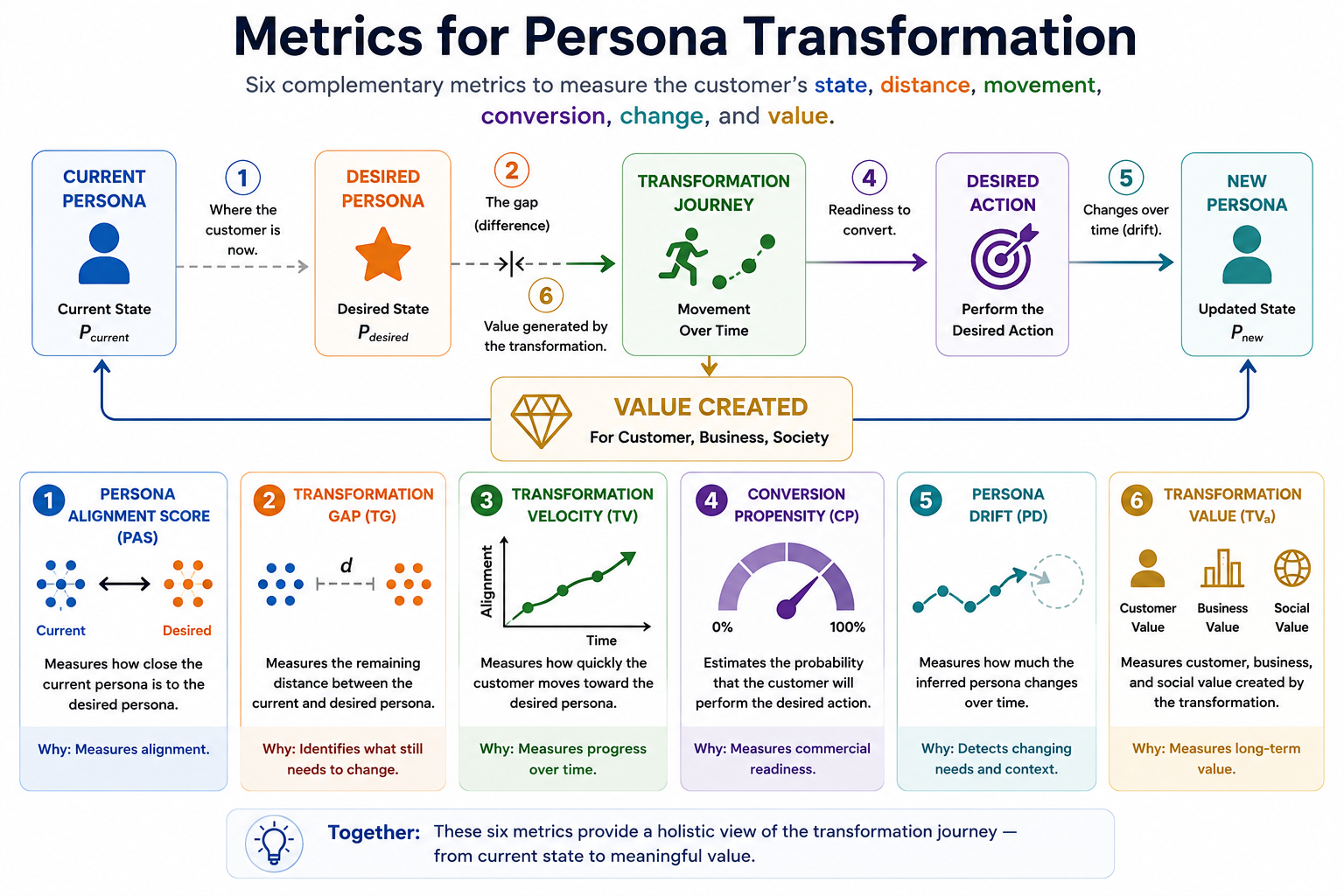
18. Metrics for Persona Transformation
The framework proposes six complementary metrics to measure the customer’s state, distance, movement, conversion, change, and value.
| Metric | Meaning | Why |
|---|---|---|
| Persona Alignment Score (PAS) | Measures how close the current persona is to the desired persona. | Measures alignment. |
| Transformation Gap (TG) | Measures the remaining distance between the current and desired persona. | Identifies what still needs to change. |
| Transformation Velocity (TV) | Measures how quickly the customer moves toward the desired persona. | Measures progress over time. |
| Conversion Propensity (CP) | Estimates the probability that the customer will perform the desired action. | Measures commercial readiness. |
| Persona Drift (PD) | Measures how much the inferred persona changes over time. | Detects changing needs and context. |
| Transformation Value (TVa) | Measures customer, business, and social value created by the transformation. | Measures long-term value. |
18.1 Persona Alignment Score
A higher PAS indicates that the customer’s current persona is closer to the desired persona.
18.2 Transformation Gap
A larger TG indicates that more transformation is required.
18.3 Transformation Velocity
A positive value indicates movement toward the desired persona.
18.4 Conversion Propensity
Conversion probability should be calibrated using historical outcomes over a defined time horizon.
18.5 Persona Drift
A higher value indicates a larger change in the inferred persona.
18.6 Transformation Value
where:
- (V_c) = Customer Value
- (V_b) = Business Value
- (V_s) = Social Value
- (w_c, w_b, w_s) = strategic weights
The weights can be adapted by domain and strategy. The important principle is that value should not be reduced to short-term revenue.
 {width=95%}
\newpage
19. Ethical Persona Alignment
AI-driven personalization creates a serious ethical risk. If the system learns only:
“What can make this person buy?”
it can become a sophisticated manipulation engine.
The present framework introduces a different principle:
The desired persona should primarily represent a meaningful customer objective, not merely a commercial objective imposed by the company.
Let:
represent the customer’s desired state and:
represent the company’s commercial objective.
These may overlap, but they are not automatically identical.
The system should therefore distinguish between:
and optimize within a constrained objective such as:
rather than:
Marketing 8.0 should therefore require at least four principles:
- Customer agency: the person should be able to accept, reject, or modify recommendations.
- Transparency: material personalization logic should not be intentionally deceptive.
- Data minimization: only relevant and authorized signals should be used.
- Non-manipulation: optimization should not deliberately exploit vulnerabilities merely to increase conversion.
The ethical purpose is not to eliminate commercial value, but to align commercial value with meaningful customer outcomes.
\newpage
20. Research Propositions
Ten claims this framework makes, and that future data should test. Each is stated in plain language for practitioners, alongside the formal constructs a researcher would operationalize.
\renewcommand{\arraystretch}{1.6}
| # | Plain-English Claim | What to Measure (for Researchers) |
|---|---|---|
| P1 | A dynamic customer profile beats a static segment label at explaining behavior. | Persona State Vector vs. static segment as predictors of behavior |
| P2 | AI can learn “who the customer is becoming” from enough behavioral history. | accuracy as a function of history length |
| P3 | Customers closer to their desired identity are more likely to convert. | Persona Alignment Score (PAS) vs. conversion, controlling for context |
| P4 | A conversion-readiness score helps predict who is close to taking action. | PCS as a leading indicator of Conversion Propensity (CP) |
| P5 | That score is only trustworthy once it is checked against real outcomes. | PCS calibration (Platt scaling / isotonic regression) vs. observed conversion rates |
| P6 | AI-generated content works better when it reflects the customer’s current and desired state. | Conditioned vs. unconditioned generation, effect on engagement/conversion |
| P7 | A system that learns from customer reactions personalizes better than one that doesn’t. | Closed-loop (Section 10) vs. static one-time segmentation, effect on TV |
| P8 | Focusing on customer transformation, not just conversion, builds more long-term value. | Transformation Value (TVa) vs. short-term-conversion-only optimization |
| P9 | Customers who are actively moving toward their goal stay longer and spend more. | Transformation Velocity (TV) vs. retention and lifetime value, controlling for baseline propensity |
| P10 | Aligning customer goals with business goals builds more trust than chasing quick sales. | Customer-goal/business-goal alignment vs. trust and long-term retention |
\renewcommand{\arraystretch}{1}
\newpage
21. Implications for Marketing 8.0
The proposed framework can be understood as an evolution in the object of marketing attention:
This sequence is conceptual, not an official historical taxonomy. It is a way to express the argument of the present paper.
The proposed Marketing 8.0 equation is:
The central question changes from:
What should we sell to this customer?
to:
Who is this customer now, who do they want to become, and what experience can we responsibly provide to help them move toward that state?
This shift has several managerial implications.
First, the Customer 360 model becomes more than a database. It becomes a continuously updated representation of customer state.
Second, segmentation becomes a starting abstraction rather than the final representation of the customer.
Third, Campaign Management becomes one component of a broader transformation engine.
Fourth, Generative AI becomes more valuable when it is grounded in longitudinal customer context rather than isolated prompts.
Fifth, business metrics expand beyond conversion to include alignment, transformation velocity, retention, customer value, and trust.
Finally, product strategy and customer experience become connected. A product is part of a journey rather than an isolated object in a catalog.
22. Limitations and Research Agenda
This framework is a proposed theoretical model. It should not be interpreted as an established psychological, physical, or marketing law.
22.1 Limitations
1. Human identity is difficult to represent numerically.
A Persona Vector is necessarily a simplification. Human personality, consciousness, culture, meaning, and social identity cannot be fully represented by numerical coordinates.
2. The “attractor” is a conceptual model.
The idea of an attractor is borrowed from dynamical-systems thinking. It provides a useful way to describe movement toward a desired state, but it does not imply that human development follows physical laws.
3. Jung provides a conceptual, not empirical, foundation.
Jung’s theory is historically influential, but it is not equivalent to contemporary empirical personality science. In this framework, Jung is used primarily to explain Persona, Self, identity, and transformation.
4. Persona dimensions require empirical validation.
The dimensions proposed for the Persona State Vector are illustrative. Future research must determine which dimensions are measurable, stable, predictive, and ethically appropriate.
5. Conversion Score is not automatically probability.
Persona Conversion Score is a business scoring construct.
For example:
A score of 84/100 does not mean an 84% probability of conversion.
To interpret the score as probability, the model must be calibrated and validated against historical outcomes.
6. Correlation does not establish causation.
A customer’s Persona may change because of factors outside marketing, such as life events, economic conditions, relationships, health, or changes in personal goals.
Therefore:
Observed transformation does not necessarily mean that marketing caused the transformation.
7. Desired Personas can change.
Customers may have multiple goals, conflicting identities, or changing aspirations. The Desired Persona should therefore be treated as a dynamic state, rather than a permanent target.
8. AI introduces new risks.
Deep Learning and Generative AI can introduce bias, hallucinations, inappropriate recommendations, privacy risks, or unwanted persuasion.
Responsible deployment therefore requires:
- clear objectives;
- data governance;
- model evaluation;
- transparency;
- human oversight in higher-risk contexts;
- mechanisms for customer control and rejection.
22.2 Research Agenda
The framework creates several directions for future research.
| Priority | Research Question |
|---|---|
| 1. Persona Dimensions | Which dimensions provide a reliable representation of a customer’s Persona State? |
| 2. Persona Distance | Which distance metrics best represent meaningful differences between personas? |
| 3. Longitudinal Learning | Can Deep Learning reliably detect Persona changes over time? |
| 4. Transformation Effects | Do transformation-oriented interventions produce better long-term outcomes than conversion-only strategies? |
| 5. Ethics and Governance | How can AI personalization support transformation without manipulating customer autonomy? |
Future research should therefore move from conceptual modeling toward empirical validation:
The ultimate research challenge is not simply to predict what customers will do, but to determine whether AI can reliably understand who customers are, how they are changing, and which interventions create meaningful value without compromising human autonomy.
23. Conclusion
This paper proposes a fundamental shift in how personalization understands the customer.
The customer should not be treated simply as:
a segment, profile, or conversion opportunity.
Instead, the customer can be understood as:
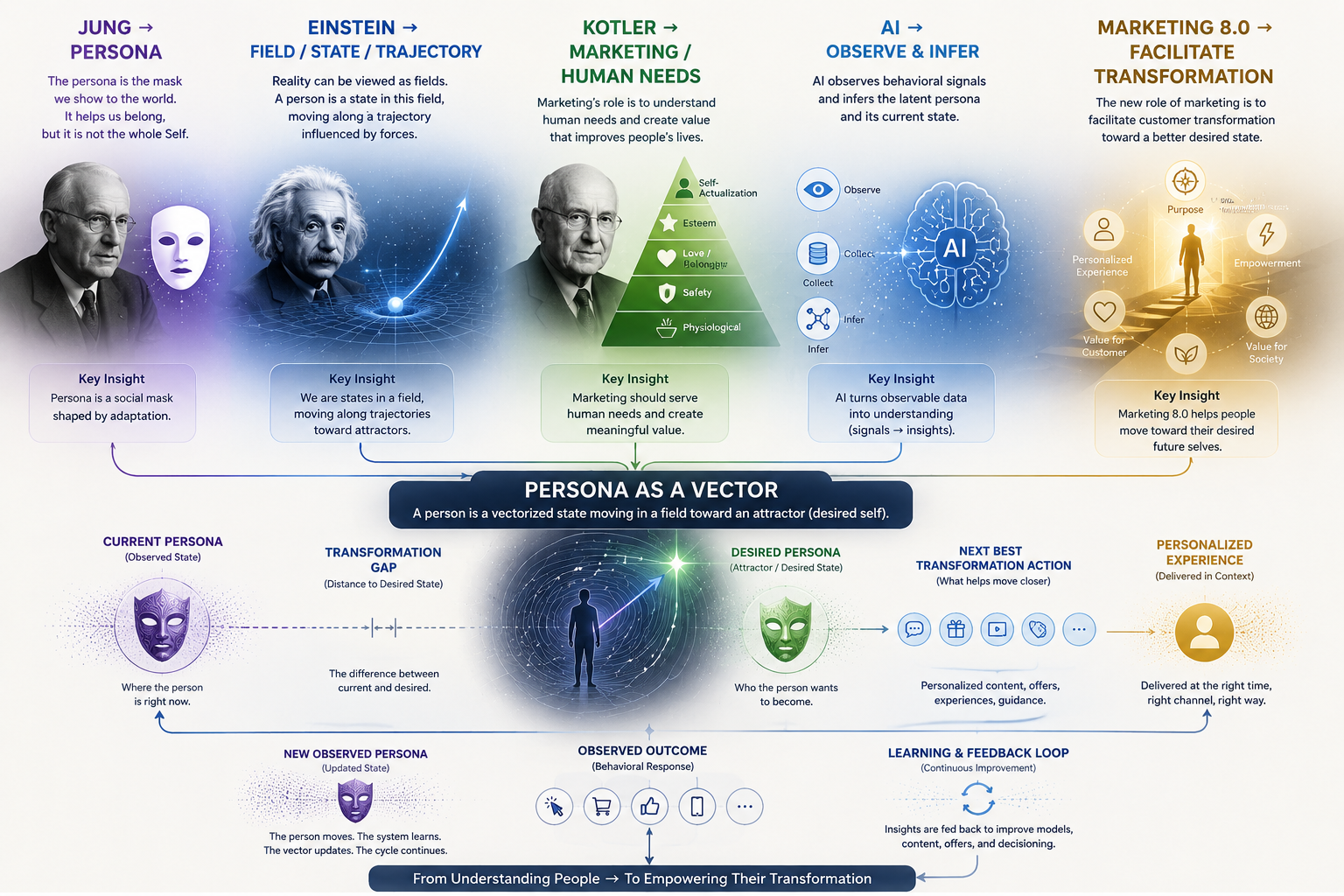
a dynamic Persona moving through a space of possible states.
 {width=95%}
The proposed framework can be summarized as:
Within this framework, each technology has a distinct role.
Deep Learning provides the mechanism for understanding the current Persona state from observable behavioral signals.
Persona Conversion Scoring provides the mechanism for estimating readiness for action.
Generative AI provides the mechanism for creating adaptive and contextual interventions.
Personalization provides the mechanism for delivering those interventions to the individual.
Customer Journey provides the mechanism for observing how the Persona changes over time.
The Desired Persona functions as a conceptual attractor: a state toward which the customer may move through a sequence of experiences, decisions, and behavioral changes.
The system therefore becomes a continuous learning loop:
The deeper implication is that a consumer decision should not be viewed as an isolated event.
A purchase, click, subscription, renewal, or rejection is often the visible consequence of a deeper chain involving:
Therefore:
This changes the fundamental question of personalization.
Instead of asking:
“What should we sell to this customer?”
the system asks:
“Who is this person now, who do they want to become, and what experience could responsibly help them move toward that state?”
This distinction is critical for the future of AI-driven marketing. A more powerful personalization engine should not simply become better at predicting and manipulating customer behavior. It should become better at understanding human context, respecting customer agency, and creating meaningful value through transformation.
In this sense, the future of personalization is not merely about giving every person a different message.
It is about:
understanding the current Persona, recognizing the Desired Persona, reducing the Transformation Gap, and creating experiences that help the person move from one state to another.
The ultimate object of Marketing 8.0 is therefore not simply the transaction.
Rather:
The transaction remains important. But it becomes a consequence within a larger human journey.
The future of marketing is not only about influencing what people buy. It is about helping people become who they aspire to be.
\newpage
References
Theoretical Foundations: Psychology and Physics
Einstein, A. (1915). The Field Equations of Gravitation. Sitzungsberichte der Preussischen Akademie der Wissenschaften, 844–847.
Einstein, A. (1916). Die Grundlage der allgemeinen Relativitätstheorie. Annalen der Physik, 49, 769–822. https://doi.org/10.1002/andp.19163540702
Jung, C. G. (1921). Psychologische Typen. Zürich: Rascher & Cie.
Jung, C. G. (1959). The Archetypes and the Collective Unconscious. In The Collected Works of C. G. Jung, Vol. 9, Part 1. Princeton University Press.
Marketing and Customer Experience
Kotler, P., Kartajaya, H., & Setiawan, I. (2026). Marketing 7.0: A Guide for Thinking Marketers in the Age of AI. John Wiley & Sons.
Identity Resolution and Data Integration
Christen, P. (2012). Data Matching: Concepts and Techniques for Record Linkage, Entity Resolution, and Duplicate Detection. Springer. https://doi.org/10.1007/978-3-642-31164-2
Elmagarmid, A. K., Ipeirotis, P. G., & Verykios, V. S. (2007). Duplicate record detection: A survey. IEEE Transactions on Knowledge and Data Engineering, 19(1), 1–16.
Machine Learning: Sequence Models and Representation Learning
Hochreiter, S., & Schmidhuber, J. (1997). Long short-term memory. Neural Computation, 9(8), 1735–1780. https://doi.org/10.1162/neco.1997.9.8.1735
Vaswani, A., Shazeer, N., Parmar, N., Uszkoreit, J., Jones, L., Gomez, A. N., … & Polosukhin, I. (2017). Attention is all you need. Advances in Neural Information Processing Systems (NeurIPS), 30, 5998–6008.
Kalman Filtering and Bayesian State Estimation
Kalman, R. E. (1960). A new approach to linear filtering and prediction problems. Journal of Basic Engineering, 82(1), 35–45. https://doi.org/10.1115/1.3662552
Contextual Bandits and Exploration-Exploitation
Thompson, W. R. (1933). On the likelihood that one unknown probability exceeds another in the light of the evidence of two samples. Biometrika, 25(3–4), 285–294.
Chu, W., Li, L., Reyzin, L., & Schapire, R. E. (2011). Contextual Bandits with Linear Payoff Functions. Proceedings of the Fourteenth International Conference on Artificial Intelligence and Statistics (AISTATS), 208–214.
Li, L., Chu, W., Langford, J., & Schapire, R. E. (2010). A contextual-bandit approach to personalized news recommendation. Proceedings of the 19th International Conference on World Wide Web, 661–670. https://doi.org/10.1145/1772690.1772758
Offline and Batch-Constrained Reinforcement Learning
Kumar, A., Zhou, A., Tucker, G., & Levine, S. (2020). Conservative Q-learning for offline reinforcement learning. Advances in Neural Information Processing Systems (NeurIPS), 33, 1346–1357.
Fujimoto, S., Meger, D., & Precup, D. (2019). Off-policy deep reinforcement learning without exploration. International Conference on Machine Learning (ICML), 2052–2062.
Off-Policy Evaluation and Importance Sampling
Precup, D., Sutton, R. S., & Singh, S. P. (2000). Eligibility traces for off-policy policy evaluation. International Conference on Machine Learning (ICML), 759–766.
Thomas, P., & Brunskill, E. (2016). Data-efficient off-policy policy evaluation for reinforcement learning. International Conference on Machine Learning (ICML), 2139–2148.
Causal Inference and Heterogeneous Treatment Effects
Kunzel, S. R., Sekhon, J. S., Bickel, P. J., & Yu, B. (2019). Metalearners for estimating heterogeneous treatment effects using machine learning. Proceedings of the National Academy of Sciences, 116(10), 4156–4165. https://doi.org/10.1073/pnas.1804597116
Wager, S., & Athey, S. (2018). Estimation and Inference of Heterogeneous Treatment Effects using Random Forests. Journal of the American Statistical Association, 113(523), 1228–1242.
Athey, S., Tibshirani, J., & Wager, S. (2019). Generalized random forests. Annals of Statistics, 47(2), 1148–1178.
Probability Calibration
Platt, J. C. (1999). Probabilistic outputs for support vector machines and comparisons to regularized likelihood methods. Advances in Large Margin Classifiers, 10(3), 61–74.
Niculescu-Mizil, A., & Caruana, R. (2005). Predicting good probabilities with supervised learning. Proceedings of the 22nd International Conference on Machine Learning (ICML), 625–632. https://doi.org/10.1145/1102351.1102430
References: Psychology and Identity
Library of Congress. The Red Book of Carl Jung: The Red Book and Beyond. U.S. Library of Congress.
American Psychological Association. APA Dictionary of Psychology. Entries on self and individuation.
Acknowledgment
The author used ChatGPT as an AI-assisted research and writing tool for ideation, conceptual development, language refinement, and document formatting. The theoretical framework, arguments, interpretations, and final content remain the responsibility of the author.