Customer 360 — vServer → VKS (Managed Kubernetes) Technical Analysis
Status: research / decision-support · Date: 2026-08-26 · Scope: UAT + PROD Platform: GreenNode / VNG Cloud, zone HCM03-1C (object storage in HCM04) Companion:
vks-cost-analysis.md
This document evaluates replacing the current vServer (VM + Docker + SSH) deployment with VKS — VNG Cloud Kubernetes Service (rebranded GreenNode Kubernetes Service). It covers the target architecture, a component-by-component migration map, the UAT and PROD specifics, and the risks/gotchas that are particular to VKS and to this account.
1. TL;DR
- Technically a good fit. Nearly every workload is already a stateless Docker container
pulled from GHCR and run with
--restart unless-stopped; those become KubernetesDeployments almost 1:1. Managed PostgreSQL and (in prod) managed MemStore stay outside the cluster unchanged. - The migration mostly deletes accidental complexity that exists only because we are on
VMs:
--network host+ 127.0.0.1 wiring + non-standard ports, hand-maintained cross-box security-group rules, Caddy + a cutover runbook, Portainer + agents, an SSH bash deploy pipeline, and DHCP-guessed private IPs. See §7. - VKS control plane is free; you pay only for worker-node VMs, block-storage PVCs, and load balancers — the same resource types you already pay for. See the cost doc.
- Main caveats for this account: only HCM03-1C is enabled → no cross-AZ HA even
though VKS supports multi-AZ; VNG force-upgrades clusters after a version’s end-of-support;
every
Service type=LoadBalancerprovisions a billed NLB (consolidate to one ingress); and data-tracking-api is now built by CI (✅ done — it publishes to GHCR like the others).
2. Current state (baseline)
Full inventory in the module READMEs and */overlays/{uat,prod}.tfvars. Condensed:
2.1 UAT — everything on tiny VMs
| Box | Flavor | vCPU/RAM | Runs |
|---|---|---|---|
c360-api-uat-api (10.100.1.5) | s-general-1x2 | 1 / 2 GB | customer360-api, redis, keycloak, frontend-admin, ads-server, Caddy, whole monitoring stack (Portainer, Netdata, Jaeger, pgAdmin, oauth2-proxy) |
c360-api-uat-backend (10.100.1.4) | s-general-1x2 | 1 / 2 GB | Dagster (backend-system), Portainer agent |
c360-api-uat-tracking (10.100.1.8) | s-general-1x2 | 1 / 2 GB | data-tracking-api, Portainer agent |
The api box is explicitly oversubscribed (1 vCPU/2 GB running ~11 containers; a resize to
s-general-2x4 is deferred in the overlay comment).
2.2 PROD — a dedicated VM per service
| Box | Flavor | vCPU/RAM | Runs | Status |
|---|---|---|---|---|
c360-api-prod-4x8 (…1.10) | s2-general-4x8 | 4 / 8 | customer360-api (+ monitoring) | provisioned |
c360-api-prod-sso (…1.11) | s2-general-2x4 | 2 / 4 | Keycloak | provisioned |
c360-api-prod-frontend (…1.12) | s2-general-2x4 | 2 / 4 | frontend-admin + Caddy | provisioned |
c360-api-prod-ads (…1.13) | s2-general-4x8 | 4 / 8 | ads-server | provisioned |
c360-api-prod-tracking (…1.15) | s2-general-2x4 | 2 / 4 | data-tracking-api | commented-out |
| backend/Dagster (…1.14) | — | — | Dagster | designed, no server key |
2.3 Shared (both envs)
- PostgreSQL: managed vDB, PG 15, private — UAT
db.s-general-2x4/ 20 GB; PRODdb.s-general-8x16/ 250 GB. Databasescustomer360(FORCE RLS) +db_keycloak+leo_ads. - Redis: UAT = container on the api box; PROD = managed MemStore (
db.s-general-2x4, Redis 7). - Load balancer: L4 NLB (
NLB_Small), TCP passthrough; listeners:443/:80→Caddy,:3000→Dagster,:9443→Portainer,:19999→Netdata(SSO),:5050→pgAdmin. - Reverse proxy: Caddy (
caddy:2-alpine), auto Let’s Encrypt TLS, single-host path routing (/,/c360api,/auth,/ads,/data,/jaeger). Domainbeta.leocdp.com(uat) /leocdp.com(prod). - Object storage: vStorage/S3 (
leo-customer360-{uat,prod}) for tracking NDJSON; separateleocdp360-tfstatebucket for Terraform state (via thehashicorp/awsprovider against the vStorage endpoint). - CI/CD: CI builds images → GHCR (
ghcr.io/leo-cdp/leo-customer360/<svc>, tagssha-<git>/latest/vX.Y.Z);cd.ymlrunsdeploy-all.sh <env> --only <svcs>over SSH (docker run … --network host). Terraform state on S3-over-vStorage (no state locking).
3. Target architecture on VKS
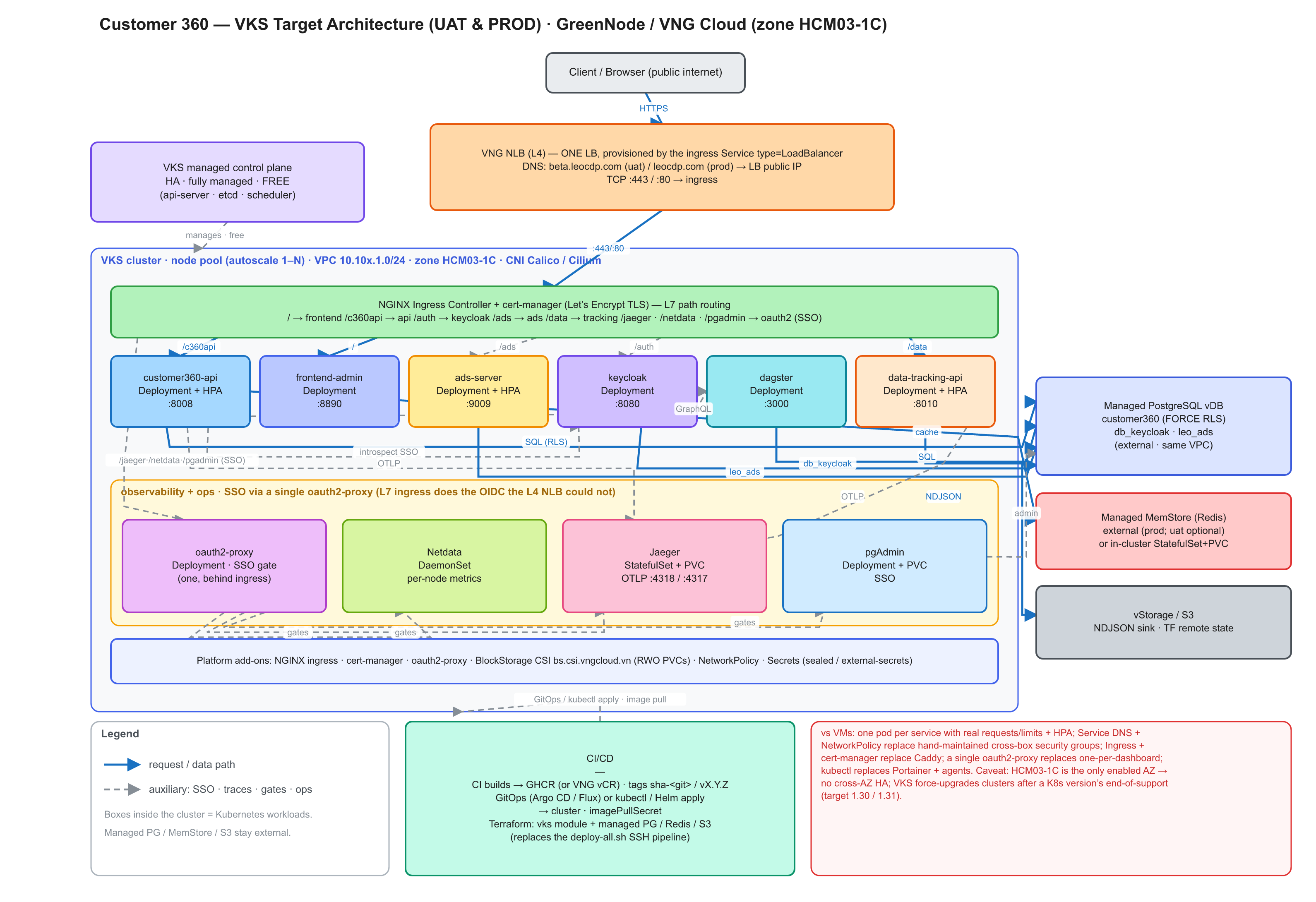
📐 Editable sources: vks-target-architecture.excalidraw
(open at excalidraw.com or the Obsidian Excalidraw plugin) ·
vks-target-architecture.svg (vector source of the image above).
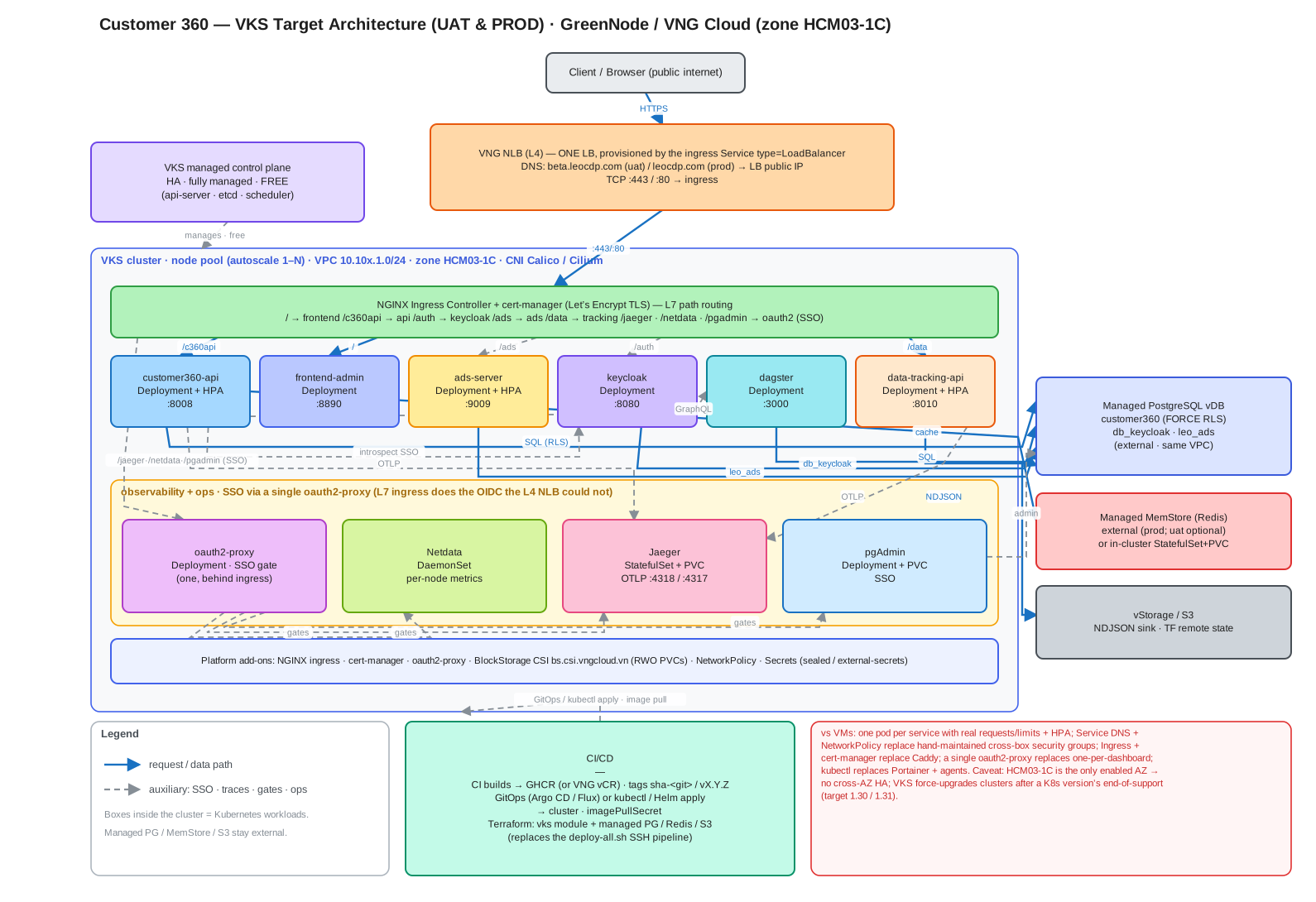
Same view as text
Internet
  │  DNS: beta.leocdp.com (uat) / leocdp.com (prod)  → LB public IP
  ▼
VNG NLB/ALB  (ONE load balancer, provisioned by the Ingress)
  ▼
Ingress controller (NGINX + cert-manager/Let's Encrypt)   ← replaces Caddy
  ├── /            → frontend-admin  (Deployment + Service)
  ├── /c360api     → customer360-api (Deployment + Service + HPA)
  ├── /auth        → keycloak        (Deployment/StatefulSet + Service)
  ├── /ads         → ads-server      (Deployment + Service + HPA)
  ├── /data        → data-tracking-api (Deployment + Service + HPA)
  ├── /jaeger      → oauth2-proxy → jaeger-query   (SSO via Keycloak)
  ├── /netdata     → oauth2-proxy → netdata        (SSO)
  └── /pgadmin     → oauth2-proxy → pgadmin         (SSO)     ← prod already SSO-gated

In-cluster (VKS node pool, VPC 10.10x.1.0/24, zone HCM03-1C):
  Deployments:  api · frontend · ads · keycloak · dagster · tracking · oauth2-proxy · pgadmin
  DaemonSet:    netdata (per-node metrics)          StatefulSet+PVC: jaeger (badger) [or in-mem]
  (redis: keep managed MemStore, OR in-cluster StatefulSet+PVC)

Outside the cluster, same VPC (unchanged):
  Managed PostgreSQL vDB (customer360 / db_keycloak / leo_ads)
  Managed MemStore (Redis)                     vStorage / S3 (NDJSON sink, TF state)
Platform add-ons to install once per cluster (Helm):
- Ingress: NGINX Ingress Controller (fronted by one NLB) or VNG’s native ALB ingress via the GreenNode LoadBalancer Controller. Recommendation: NGINX + cert-manager — it’s the documented Let’s Encrypt path and is the cleanest 1:1 replacement for Caddy’s automatic HTTPS.
- TLS: cert-manager with staging + production ACME (Let’s Encrypt) Issuers — replaces Caddy’s cert management.
- CSI: GreenNode BlockStorage CSI (
bs.csi.vngcloud.vn) for PVCs (installed/available in VKS). - oauth2-proxy: a single deployment wired into the ingress (via auth annotations) instead of one container per dashboard.
4. Component-by-component migration map
| Current (VM / Docker) | VKS target | Notes |
|---|---|---|
customer360-api container (--network host, :8008) | Deployment + Service (ClusterIP) + HPA | env-file → Secret/ConfigMap; root_path=/c360api preserved via ingress path |
| ads-server (:9009, high-QPS) | Deployment + Service + HPA | biggest autoscale beneficiary |
| frontend-admin (:8890) | Deployment + Service | static-ish; browser calls API/Keycloak via ingress |
| keycloak (:8080, mgmt :9000) | Deployment (or StatefulSet) + Service | external DB db_keycloak; set KC_HTTP_RELATIVE_PATH=/auth; liveness on :9000 |
| dagster / backend-system (:3000) | Deployment + Service | needs PG; if it needs run storage, add a PVC |
| data-tracking-api (:8010) | Deployment + Service + HPA | ✅ now built + published to GHCR by CI (ci.yml); deploy-tracking.sh pulls it by default (BUILD_LOCAL=0). Redis Streams broker plus S3 creds and OTLP endpoint must be provided via Secret/env |
| c360-redis container (uat) / MemStore (prod) | Keep managed MemStore for both (recommended) or in-cluster StatefulSet + PVC | managed removes stateful-in-cluster risk; RWO block volume only if in-cluster |
| Caddy (path routing + TLS) | Ingress + cert-manager | deletes proxy/, set-domain.sh, the cutover runbook |
| L4 NLB (manual listeners/backends) | Service type=LoadBalancer on the ingress → one VNG NLB | annotations pick package/scheme/security-groups; do not create one LB per service |
| Portainer + agents | remove → kubectl / Lens / (optional) K8s dashboard | cross-box agent pattern disappears |
| Netdata (per-host) | DaemonSet (--pid host equiv via host access) or Prometheus + Grafana | keep Netdata for parity, or modernise to Prometheus stack |
| Jaeger (badger, loopback UI, OTLP) | Deployment/Operator + Service; PVC if persisting badger | OTLP :4318/:4317 becomes a ClusterIP Service; apps point OTEL_EXPORTER_OTLP_ENDPOINT at it |
| pgAdmin (:5050, PVC data) | Deployment + PVC + ingress (oauth2 SSO) | prod already SSO-gated; uat can adopt SSO for free here |
| oauth2-proxy (one per dashboard) | one Deployment behind ingress auth annotations | L7 ingress does what the L4 NLB couldn’t |
.env files on box (/opt/c360/*.env) | Kubernetes Secrets (sealed-secrets / external-secrets recommended) | no more per-box files |
Cross-box security-group extra_ingress (9001/8010/6580/4318) | NetworkPolicy (+ intra-cluster DNS) | hand-maintained IP rules vanish |
| Hard-coded private IPs (10.10x.1.x) | Kubernetes Service DNS names | no DHCP-guessing / terraform output IP juggling |
deploy-all.sh (SSH docker run, manual ordering) | Helm/Kustomize manifests + kubectl apply or GitOps (Argo CD/Flux) | controller reconciliation replaces ordered SSH steps; --restart unless-stopped → pod restartPolicy |
Terraform: server / load_balancer / proxy modules | removed; add a vks module (cluster + node group) | keep TF for VKS, managed PG/MemStore, object storage, VPC |
| PostgreSQL vDB / object storage | unchanged (external, in-VPC) | pods get creds via Secret; S3 needs no CSI |
5. Networking, storage, secrets
- Cluster networking: create the VKS cluster in the existing VPC/subnet (
10.100.1.0/24uat,10.101.1.0/24prod). CNI: Calico Overlay, Cilium Overlay, or Cilium VPC-native routing are offered — Cilium enables richer NetworkPolicy/observability; Calico is the safe default. - Public vs Private cluster: VKS distinguishes them. Public = simplest, node↔API over public IPs; Private = all-private, needs extra endpoints, costs more and is more complex. Recommendation: Public cluster + IP-allowlisted API + private node groups where possible; only go Private if compliance demands it.
- Persistent volumes:
bs.csi.vngcloud.vn, RWO only (no shared/RWX block — use FileStorage/NFS if a workload ever needs RWX). Default SCsc-iops-200-retain;allowVolumeExpansion(grow-only); volume snapshots supported. PVC candidates: Jaeger badger, pgAdmin data, in-cluster Redis (if chosen). - Secrets: standard K8s
Secrets (no VKS-managed secret store surfaced). Recommend sealed-secrets or external-secrets so nothing sensitive lands in git. Private-registry pull uses animagePullSecret. - Registry: keep GHCR (works from VKS with a pull secret) or move to VNG vCR (
vcr.console.vngcloud.vn, IAM-gated) to keep image pulls in-cloud and cut cross-cloud egress.
6. Per-environment plan
6.1 UAT
- Single small node pool (autoscale 1→2) is plenty; UAT tolerates a single node (no HA needed). This is actually an upgrade over today’s 1 vCPU/2 GB oversubscribed box because pods get real requests/limits and the scheduler bin-packs with headroom.
- Keep it a Public cluster; adopt SSO for pgAdmin (free win vs today’s cleartext direct exposure).
- Good first migration target — low risk, exercises the whole pattern.
6.2 PROD
- Node pool of ≥2 nodes (autoscale) so a node drain/upgrade doesn’t take the platform down — but note single-AZ HCM03-1C means no cross-AZ HA; a full-AZ outage still takes everything down (same exposure as today).
- Bin-packing collapses the 4–6 dedicated boxes into a shared pool; isolate noisy/high-QPS ads via resource requests or a dedicated node pool/labels if needed.
- Keep managed PostgreSQL + MemStore external (unchanged).
- Deploy the same manifests as UAT, differing only by Helm values / Kustomize overlay (image tag
vX.Y.Z, replica counts, resource limits, domain) — this replaces the per-moduleprod.tfvarssprawl.
7. What the migration removes (accidental VM complexity)
These exist only because we run on VMs and disappear under VKS:
- Service co-location on one oversubscribed box → one pod per workload with real limits.
--network host+127.0.0.1wiring + port-clash-avoidance ports (6580/4199/4686/4050/5050/9443…) → ClusterIP Services + DNS on normal ports.- Cross-box security-group
extra_ingressrules (9001/8010/6580/4318) →NetworkPolicy. - Caddy +
set-domain.sh+ the cutover runbook → Ingress + cert-manager. - oauth2-proxy one-container-per-dashboard (because the L4 NLB can’t do OIDC/TLS) → one oauth2-proxy behind an L7 ingress.
- Portainer + agents (cross-box container ops) →
kubectl. - build-on-the-VM fallback (
BUILD_LOCAL=1, and tracking’s build-on-box default) → always deploy prebuilt images. - SSH bash deploy pipeline with manual ordering/idempotency → declarative manifests + controller reconciliation (or GitOps).
- DHCP-guessed private IPs baked into overlays → Service DNS.
- cloud-init SSH-repair boot hackery → container images.
Also worth fixing during the move (pre-existing prod placeholders, not VM-inherent): prod VPC name mismatch (c360-api-vpc-prod vs c360-vpc-prod, both create_network=true), prod cache allowed_ip_prefix=10.100.0.0/16 (should be 10.101…), prod mon_server_key="api" with no matching server key, and REPLACE_WITH_* LB/proxy placeholders.
8. Risks & VKS-specific gotchas
| Risk | Impact | Mitigation |
|---|---|---|
| Single AZ (HCM03-1C only) | VKS multi-AZ HA unavailable; AZ outage = full outage | Same exposure as today; run ≥2 nodes for node-level resilience; ask VNG to enable a 2nd AZ if HA matters |
| Forced K8s upgrades after End-of-Standard-Support | Surprise version bumps | Track the VKS release schedule; target 1.30/1.31; test upgrades in UAT first (surge upgrade: MaxSurge 1 / MaxUnavailable 0 by default) |
Each Service type=LoadBalancer bills an NLB | Cost creep | Use one ingress LB; reuse via vks.vngcloud.vn/load-balancer-id; don’t expose services individually |
| (was) can’t deploy an image | Added to ci.yml (built + pushed to GHCR); deploy-tracking.sh now defaults to BUILD_LOCAL=0, and cd.yml deploys tracking | |
| RWO block storage only | No multi-writer volumes | Single-replica stateful pods only; use FileStorage/NFS for RWX if ever needed |
| HCM03-1C pricing/flavor parity | Docs only cover HCM03-1A | Confirm flavor availability + prices for 1C with VNG before sizing |
| Stateful in-cluster (Keycloak/Jaeger/pgAdmin/Redis) | Data loss on reschedule if not persisted | Keep DB/Redis managed & external; PVC-back Jaeger/pgAdmin or accept ephemeral |
| TF state, no locking on vStorage | Concurrent-apply corruption | GitOps for the app layer sidesteps it; keep infra applies serial |
| Private-registry auth | Pull failures | imagePullSecret for GHCR, or move to vCR |
9. Recommended phased migration
- Prereqs — ✅
data-tracking-apiis now in CI (done); move.envs intoSecretmanifests (sealed/external-secrets); pick registry (GHCR vs vCR). - Cluster — Terraform a
vksmodule: cluster (Public) + one node group (autoscale) in the VPC/subnet, plus keep managed PG/MemStore/object-storage modules. - Platform — Helm-install NGINX ingress + cert-manager (Let’s Encrypt), oauth2-proxy, CSI StorageClasses; keep Netdata as a DaemonSet (or adopt Prometheus/Grafana).
- Stateless apps — deploy api, frontend, ads, keycloak, dagster, tracking; wire to external PG + MemStore; add HPAs (api, ads, tracking).
- Ingress + DNS — move
beta.leocdp.comto the ingress LB, cert-manager issues certs, retire Caddy. - Observability — Jaeger (Operator or Deployment+PVC), Netdata DaemonSet; remove Portainer.
- Cut over & decommission — validate, flip DNS, tear down the vServers +
server/load_balancer/proxyTF. - Repeat for PROD with the same manifests (Helm values differ:
vX.Y.Zimage, replicas, limits, domain, ≥2 nodes).
Do UAT end-to-end first, then PROD — the manifests are shared, so PROD becomes a values change, not a rebuild.
10. Sources
- VKS overview / control-plane-free / CNI / public-vs-private / node groups / release schedule / storage CSI / load balancer / ALB+cert-manager: docs.greennode.ai/vks/ (VNG docs now redirect here from docs.vngcloud.vn).
- vDB (RDS PostgreSQL, MemStore) + vContainer Registry: docs.vngcloud.vn / vngcloud.vn/product/.
- Current-state facts: this repo’s
deployments/*/overlays/{uat,prod}.tfvars, module READMEs,deploy-*.sh,lib/ghcr.sh,.github/workflows/cd.yml.
See vks-cost-analysis.md for the cost model and the (calculator-only) pricing to confirm with VNG.