Python Services Code Review — LEO Customer 360
Date: 2026-09-05 Scope: All Python code services in this repository (~37,000 lines across 7 services) Method: Maximum-recall, multi-angle review (10 finder angles per service, run in parallel, then per-finding verification against the source and DB schema). See Methodology.
This review prioritizes recall — surfacing every real bug. Findings are grouped by severity and each carries a file/line, a concrete failure scenario, and a fix. The three Excalidraw diagrams under
diagrams/explain the most important systemic problems visually.
1. Executive summary
The platform is a multi-tenant Customer Data Platform. Its README states tenant isolation
is a core guarantee (“strict tenant_id filtering on all operations”), and the database
implements this with PostgreSQL Row-Level Security (RLS) keyed on
current_setting('app.tenant_id').
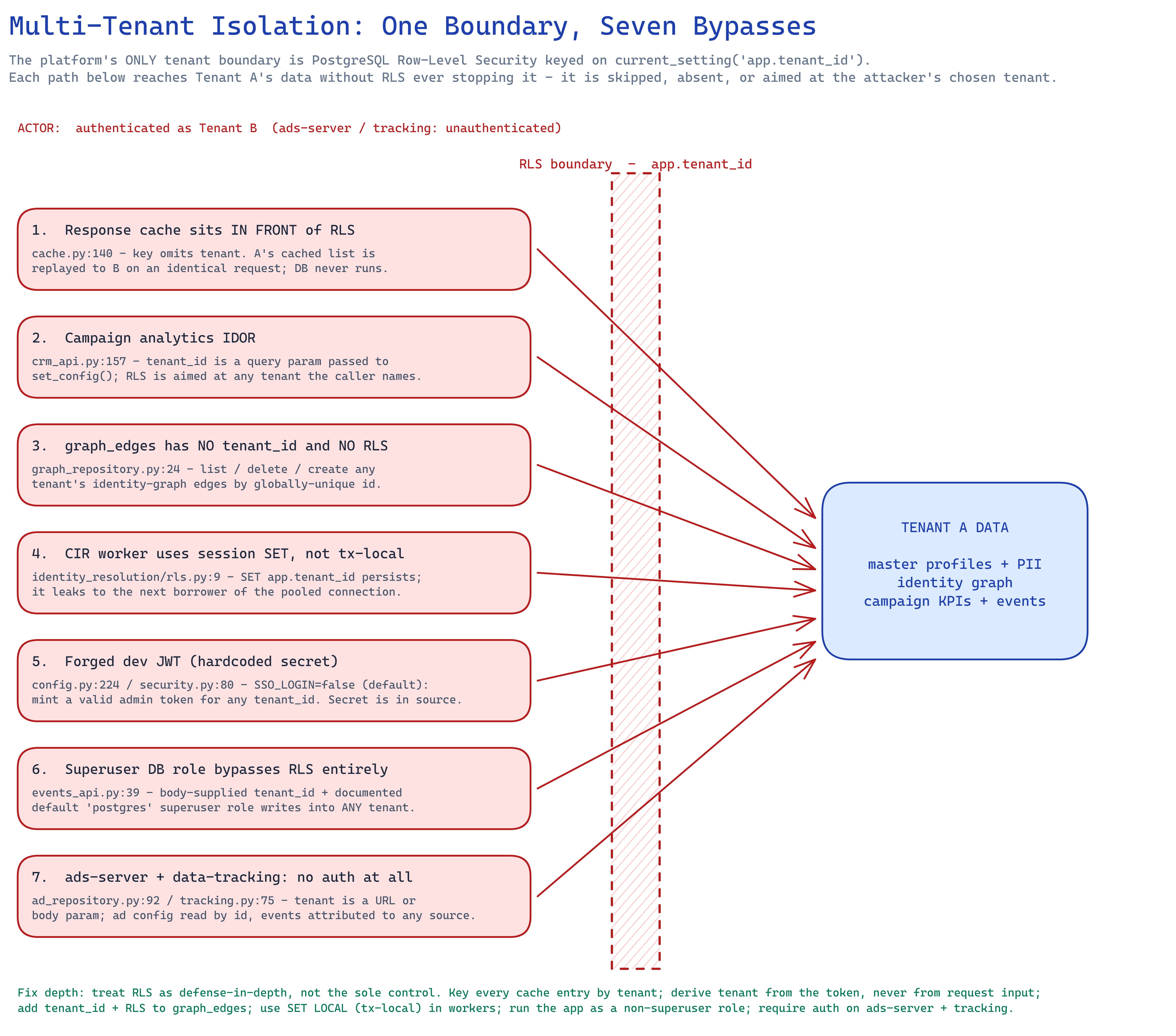
The single most important finding of this review is that this one tenant boundary is bypassable in at least seven independent ways. Because RLS is the only enforced boundary, each bypass is a direct cross-tenant data breach — of PII, the identity graph, campaign analytics, or event streams. On top of that, the identity-resolution engine (the heart of a CDP) can merge two different real people into one “golden record” irreversibly.
| Severity | Count | Examples |
|---|---|---|
| 🔴 Critical | 6 | Response cache leaks PII across tenants; graph_edges has no tenant isolation; campaign-analytics IDOR; forged dev-JWT auth bypass; identity over-merge; CIR worker RLS leak across pooled connections |
| 🟠 High | 13 | Keycloak TLS verification off by default; admin authz disabled when SSO off; unauthenticated event ingestion; ingestion OOM; analytics permanent undercount; segment-rule SQL tautology |
| 🟡 Medium | 25 | Ads served past flight/budget; timing-unsafe root password; privilege escalation on user CRUD; pipeline runaway recompute; persona/centroid drift; non-idempotent event writes |
| ⚪ Low | 18 | Wildcard CORS; non-atomic lockout counter; naive datetimes; misnamed Dagster job; unbounded Redis keys |
| Total | 62 |
Dominant themes (see Cross-cutting themes):
- RLS is treated as the sole control instead of defense-in-depth — and it is bypassed everywhere.
- Tenant identity is repeatedly taken from caller input (query param, body, header) instead of the authenticated token.
- “Dev mode” (
SSO_LOGIN=false, the default) silently disables authentication and authorization. - Identity resolution has no confidence gating or identifier normalization, corrupting the golden record.
- Caches and pipelines sit in front of the security/consistency boundary and skip it on the hot path.
2. Priority remediation roadmap
Fix in this order — the first five are exploitable cross-tenant data breaches that need no special access.
| # | Action | Findings |
|---|---|---|
| 1 | Add the authenticated tenant to every response-cache key (or disable caching on tenant-scoped routes). | C1 |
| 2 | Add tenant_id + RLS to graph_edges; scope every GraphRepository query. | C2 |
| 3 | Derive tenant from the token, never from a query param/body/header; reject requests where they disagree. | C3, H4, M4, M6 |
| 4 | Remove the hardcoded dev-JWT secret; refuse to boot with a default secret; make SSO_LOGIN=false fail-closed for authz. | C4, H2, H3 |
| 5 | In the CIR worker, use transaction-local SET LOCAL / set_config(...,true); run the app as a non-superuser DB role and rely on FORCE RLS. | C6, M7 |
| 6 | Rework identity matching: gate merges on an identifier-strength confidence score, normalize email/phone, add transitive-merge + deterministic tie-breaks. | C5, H1, H10, H11, M13 |
| 7 | Make ingestion + analytics idempotent and bounded; add auth to data-tracking-api and ads-server. | H5, H6, H7, H8, M21 |
3. Visual explanations
3.1 One tenant boundary, seven bypasses 🔴
The platform’s only tenant boundary (PostgreSQL RLS) is skipped, absent, or aimed at the attacker’s chosen tenant in seven independent code paths.
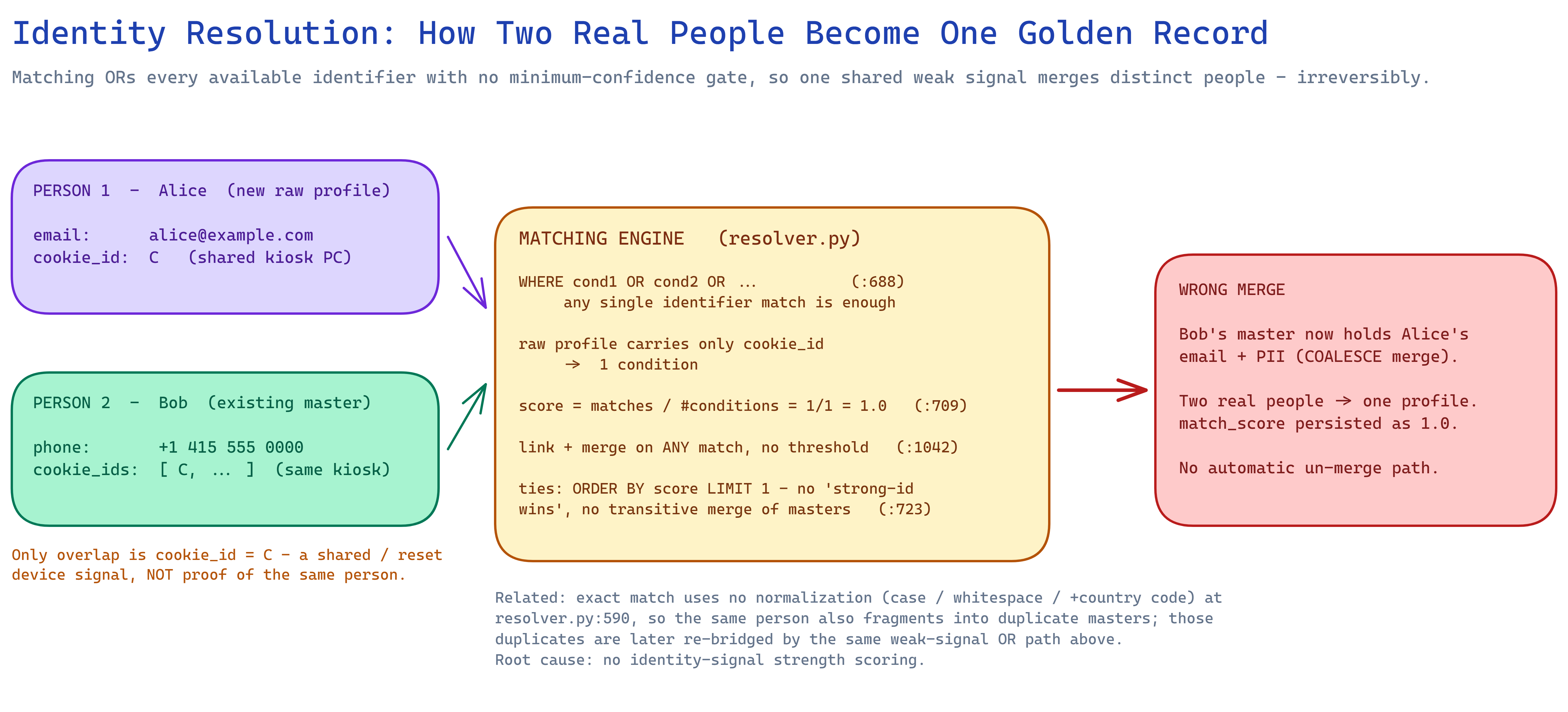
3.2 Identity resolution: how two real people become one golden record 🔴
Matching ORs every available identifier with no minimum-confidence gate, so a single shared weak signal (a kiosk cookie) merges distinct people — irreversibly.
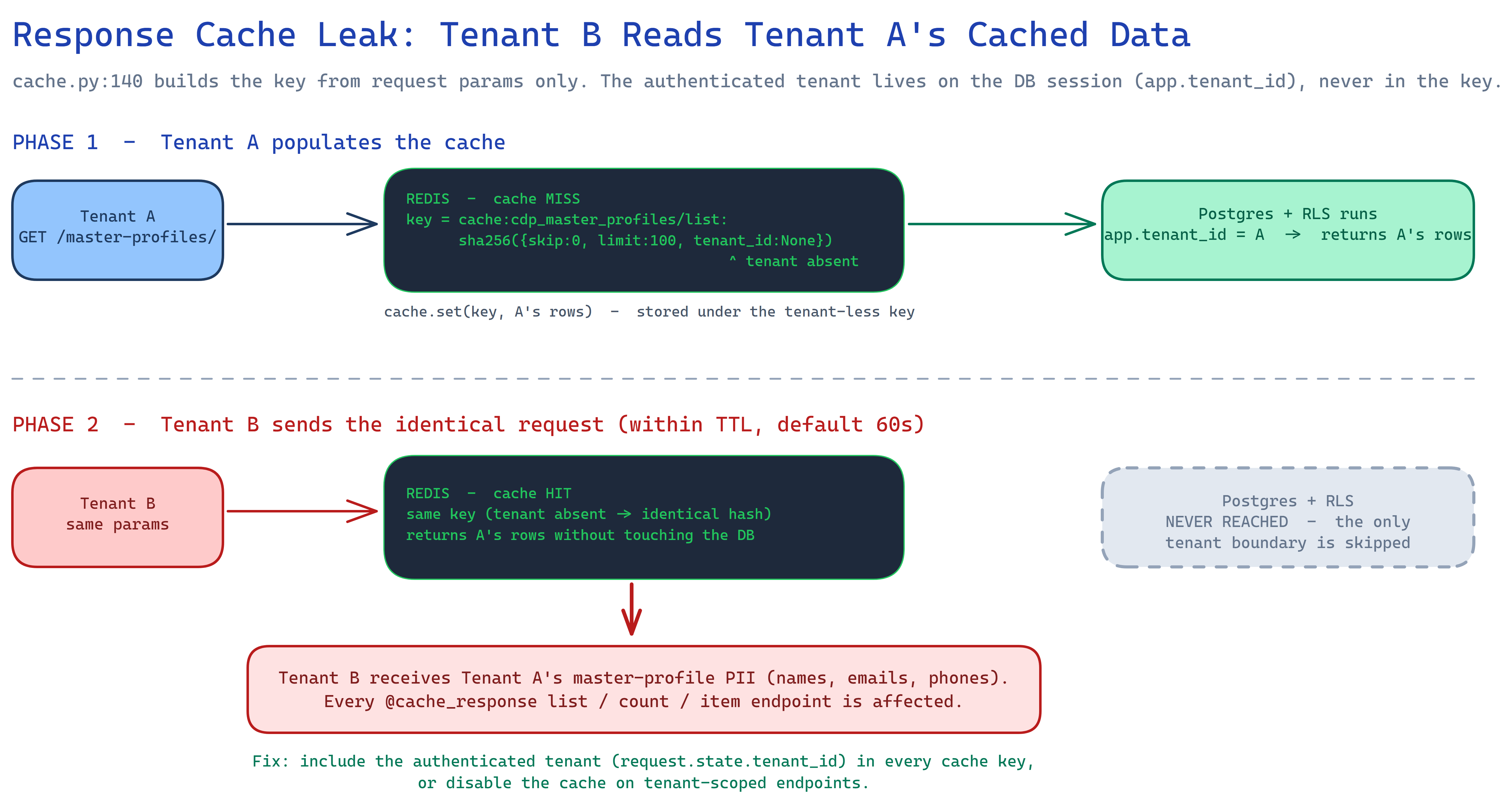
3.3 Response cache cross-tenant leak (sequence) 🔴
The cache key is built from request params only; the authenticated tenant lives on the DB session and is never in the key, so Tenant B replays Tenant A’s cached PII.
The
.excalidrawsources are indiagrams/and can be opened/edited at excalidraw.com.
4. Cross-cutting themes
- RLS as a single point of failure.
app.tenant_idRLS is correct at the DB layer (FORCE RLS +WITH CHECK), but every layer above it either bypasses it (cache), disables it (superuser role), points it at the wrong tenant (caller-suppliedtenant_id), or forgets it (graph_edgeshas notenant_id). Isolation must be enforced independently at the application layer too. - Trusting caller-supplied identity.
crm_api(query param),events_api/create routes (body), and the auth middleware (X-Tenant-Id header, dev mode) all take the tenant from the request instead of the verified token. - Dev defaults that fail open.
SSO_LOGIN=falseis the default and it early-returns fromrequire_admin, the analytics permission check, and segment-seed checks; the dev-JWT secret is hardcoded in source; Keycloak TLS verification defaults off. Any of these turns a demo default into a production breach. - Hot paths that skip the boundary. The response cache returns before RLS runs; the analytics job commits Redis counters before the durable Postgres total; ingestion validates size after the whole body is parsed. Each optimizes latency at the cost of correctness/safety.
- IP-based rate limiting behind a proxy. Three services key limits on
request.client.host, which is the load-balancer IP in production — collapsing all clients into one bucket (DoS) and defeating per-client throttling.
5. Detailed findings
🔴 Critical
C1 — Response cache leaks data across tenants
- Where:
customer360-api/core/cache.py:140, wired bycustomer360-api/core/routers/_generic.py:44-51 - What:
cache_responsebuilds the Redis key only from primitive request kwargs (_CACHEABLE_PARAM_TYPES). TheSession(which carries the token’s tenant viaapp.tenant_id) is excluded, and the optionaltenant_idquery param defaults toNone. The cache sits in front of the DB, so on a hit RLS never runs. - Scenario: Tenant A calls
GET /api/v1/master-profiles/→ RLS returns A’s rows → cached underhash({skip:0, limit:100, tenant_id:None}). Tenant B issues the identical request → same key → cache HIT → B receives A’s master-profile PII. Affects every@cache_responselist/count endpoint (identity, crm, events, relations, content, persona, reporting) and item-by-UUID endpoints. (Independently reported by two review passes.) - Fix: Include
request.state.tenant_idin every cache key; or disable caching on tenant-scoped routes. Namespaceinvalidate_prefixper tenant too.
C2 — graph_edges has no tenant column and no RLS
- Where:
customer360-api/core/repositories/graph_repository.py:24; schemadatabase-init/database-schema.sql:2533(verified: onlyfrom_id/to_id, notenant_id; absent from every RLS migration). - What: The identity-graph edge table is not tenant-scoped at the DB layer, and
GraphRepositorylist/get/delete/create issue no tenant filter. - Scenario: Any authenticated user of any tenant calls
GET /api/v1/graph-edges/and receives every tenant’s edges (from_id/to_id/keywords/metadata/embedding), orDELETE /api/v1/graph-edges/{id}to destroy another tenant’s relationship, or POSTs unscoped edges. Cross-tenant read, enumeration, and tampering of the identity graph. - Fix: Add
tenant_id UUID NOT NULLtograph_edges(+ partitions), enable/force RLS with the standardtenant_policy, and scope allGraphRepositoryqueries.
C3 — Campaign-analytics IDOR (tenant from query param)
- Where:
customer360-api/core/routers/crm_api.py:157→customer360-api/core/repositories/campaign_repository.py:38-43 - What:
get_campaign_summary/list_campaign_metrics/get_spend_trend/get_top_campaignstaketenant_id: uuid.UUID = Query(...)and pass it toCampaignRepository, whose_set_tenant_context()runsset_config('app.tenant_id', :tid, true)with that caller-supplied value — overriding the token tenant. There is no check that the querytenant_idequalsrequest.state.tenant_id. - Scenario: A user from Tenant A calls
GET /api/v1/campaigns/analytics/summary?tenant_id=<Tenant B UUID>and receives Tenant B’s spend/revenue/campaign metrics. Works even with a correctly hardened RLS role, because the app itself aims RLS at the attacker’s tenant. - Fix: Ignore any body/query tenant for scoping; derive it from the token.
C4 — Hardcoded dev-JWT secret → full auth bypass in default mode
- Where:
customer360-api/core/config.py:224(dev_jwt_secretdefault"dev-insecure-secret-change-me-please-32b"),customer360-api/core/utils/security.py:80(jwt.decode(token, settings.dev_jwt_secret, ...)). - What: When
SSO_LOGIN=false(the default), the middleware accepts any HS256 token signed withdev_jwt_secret, trusting itstenant_id/user_id/rolesverbatim. The fallback secret is in source and there is no refusal-to-boot on the default. - Scenario: Attacker forges
{"tenant_id":"<victim>","user_id":"x","roles":["admin"]}signed with the known default → authenticated as any tenant with admin rights, no credentials. (Independently reported by two review passes.) - Fix: No hardcoded default; fail startup if
SSO_LOGIN=falseand the secret is unset or equals the sample. Prefer disabling dev tokens outside dev entirely.
C5 — Identity resolution over-merges distinct people
- Where:
backend-system/identity_resolution/identity_resolution/resolver.py:688(OR of all conditions) and:1042-1050(link + merge on any match, no threshold). - What:
_find_master_profileORs every identifier the raw profile happens to carry (email, phone, and weak signals likedevice_id/advertising_id/cookie_id, all seeded as active exact rules). A match on any single one links + COALESCE-merges PII, with no minimum-confidence gate. - Scenario: A raw profile whose only identifier is
cookie_id=C(a shared kiosk/family browser, or a reset+reissued cookie) equal to Bob’s master is linked to Bob and its PII merged in. Two different real people become one golden record. No automatic un-merge. - Fix: Score matches by identifier strength and require a minimum confidence for auto-merge; route weak-signal-only matches to review. See diagram 3.2.
C6 — CIR worker sets RLS tenant with session SET, leaking across pooled connections
- Where:
backend-system/identity_resolution/identity_resolution/rls.py:9(cursor.execute("SET app.tenant_id = %s", (value,))); same pattern inbackend-system/analytics/source_analytics/tracking_log_aggregation.py:65andbackend-system/segmentation/segmentation/rls.py:9. - What:
SETis session-scoped, not transaction-local. The schema explicitly prescribes tx-localset_config('app.tenant_id', t, true)(database-schema.sql:2925), whichcustomer360-apicorrectly uses.run_resolution_batchcommits leavingapp.tenant_idpinned to the last tenant processed. - Scenario: With a connection pool (the resolver’s docstring allows a “pool checkout”), the next borrower that relies on RLS reads/writes the previous tenant’s rows → cross-tenant identity leak/corruption.
- Fix: Use
SET LOCAL/set_config(..., true)and reset context on connection return.
🟠 High
H1 — Wrong-master merge + no transitive merge. resolver.py:723 — when a raw profile
bridges two masters, ORDER BY score DESC LIMIT 1 breaks exact ties arbitrarily (no
“strong-identifier wins”), so PII can be written to the wrong master; the two pre-existing
masters are never merged, leaving identities fragmented even in the correct case.
H2 — Keycloak introspection disables TLS verification by default. auth.py:91 uses
ssl._create_unverified_context() when keycloak_verify_ssl is false (the config default). An
on-path attacker returns {"active":true, ...} for any bearer token → auth bypass / identity
spoofing in SSO/prod.
H3 — Admin authorization disabled when SSO_LOGIN=false. auth.py:436 — require_admin
returns immediately (no role check) in the default non-SSO mode; same early-return in
analytics_api.py:50 (_enforce_analytics_permissions) and segment seed/recompute checks. Any
valid dev token can perform admin-only actions (delete data sources, trigger recompute, run
cross-tenant analytics).
H4 — Unauthenticated event ingestion, tenant from body. data-tracking-api/core/routers/tracking.py:75
— POST /tracking/logs has no auth dependency and trusts data_source_id from the body to
select the tenant bucket + session cache. Any caller writes fabricated events into a victim
tenant’s data-tracking-<uuid> bucket → cross-tenant event mis-attribution / poisoning.
H5 — Ingestion OOM (size guard runs after full body parse). tracking.py:48 — the
max_events_per_request/413 check runs inside the handler, after FastAPI/Pydantic has already
materialized the entire events list into RAM; no request-body cap is configured. A single huge
POST balloons worker RSS and OOM-kills it, dropping all in-flight requests.
H6 — Empty-string identity 422-drops the whole batch (resolved in the current implementation). The tracking API now intentionally rejects blank or malformed identity values and requires a usable batch- or event-level identity before enqueueing. Clients should omit an identity until it exists rather than send an empty string; bot-filtered requests are discarded before this service validation path.
H7 — ads-server read endpoints have no auth and no tenant scope. ads-server: GET /ads/{ad_id}
→ ad_repository.py:92 filters only ad_id + status; GET /placements/{placement_key} →
placement_repository.get_active_by_key defaults tenant_id=None (no filter). No auth exists on
the service. Any client enumerates sequential ad_ids to read every tenant’s ad config
(campaign/creative/targeting/metadata_), and reads any tenant’s placement by key.
H8 — Analytics permanently undercounts on retry. tracking_log_aggregation.py:394 — per-object
Redis checkpoints + HINCRBY commit immediately, but the durable
sys_data_source.total_tracked_event is written once after the loop. A transient failure +
RetryPolicy retry resumes after the saved cursor, so already-checkpointed objects are never
re-listed and their counts never reach Postgres → the durable per-source total is silently wrong
forever.
H9 — Segment-rule denylist allows a SQL tautology. segmentation/segmentation/recompute.py:111
— _is_safe_where_fragment blocks ;, comments, and DML/DDL keywords but not parentheses. A
stored sql_rules value like email IS NOT NULL) OR (1=1 yields
... AND (email IS NOT NULL) OR (1=1); since AND binds tighter than OR, it matches every row,
defeating both the status_code and tenant_id filters (and, without FORCE RLS, enumerates other
tenants’ profile IDs). Use an allowlist parser, not a denylist.
H10 — match_score is normalized by the number of conditions present. resolver.py:709 —
score = matches / len(conditions) where conditions depends on which fields the raw profile
happens to have. A lone cookie_id match scores 1/1 = 1.0 — a “perfect” match with zero
corroboration — so match_score can’t distinguish a 1-of-1 weak hit from a 3-of-3 strong hit and
is useless as a confidence gate.
H11 — Configured matching columns are silently dropped (or crash if added). resolver.py:77 —
RAW_PROFILE_COLUMNS omits address_line1/city/postal_code/country/company_name, which
init-core-database.sql marks as active identity-resolution rules (the only fuzzy rules). They
never fire, so configured keys are ignored and admins see no effect. If a maintainer “fixes” it by
selecting them, _build_match_condition emits similarity(city, ...)/city = %s against
cdp_master_profiles where those are not columns (address is JSONB) → every batch throws.
H12 — Concurrent CIR runs double-process staging rows. resolver.py:998 fetches
status_code=1 rows with no FOR UPDATE SKIP LOCKED, and _create_master_and_link inserts the
link with no ON CONFLICT; the Dagster sensor (identity_resolution/dagster_defs.py:103) yields
RunRequest() every 30s with no run_key/in-flight guard. If a drain exceeds the interval, two
runs process the same rows → duplicate masters, then a UNIQUE(tenant_id, raw_profile_id)
violation rolls back the entire multi-tenant batch.
H13 — IP rate limiting ignores X-Forwarded-For. customer360-api/core/auth.py:60 &
auth_api.py:50, and data-tracking-api/core/redis_cache.py:96 all key on
request.client.host. Behind an ingress/LB that is the proxy IP for everyone: one abuser trips
the shared counter and 429/401s all legitimate users (DoS), while real per-client throttling never
engages. Parse a trusted X-Forwarded-For.
🟡 Medium findings
| ID | Location | Issue | Impact |
|---|---|---|---|
| M1 | ads-server/repository/ad_repository.py:258 | Serving query checks only a.status='active'; no campaign/creative status, flight window (starts_at/ends_at), or budget | Serves paused/expired/out-of-flight ads |
| M2 | ads-server/repository/ad_repository.py:267 | No-ad fallback selects tenant’s top ads across all placements, ignoring placement_id | Wrong-placement creative served into the slot |
| M3 | customer360-api/core/routers/auth_api.py:143 | Root-admin password compared with == (not hmac.compare_digest) | Timing side-channel on the highest-value account |
| M4 | customer360-api/core/routers/metadata_api.py:63 | GET /metadata/domains filters by caller tenant_id; sys_tenant_domain has no RLS | Cross-tenant enumeration of enabled domains |
| M5 | customer360-api/core/routers/user_api.py:232 | create/update/delete_user require only an ACTIVE user, no admin role | Intra-tenant privilege escalation / hard-delete of other users |
| M6 | customer360-api/core/routers/events_api.py:39 | Create routes take tenant_id from body, no check vs token | Cross-tenant writes if DB role bypasses RLS (default postgres superuser) |
| M7 | backend-system/analytics/.../tracking_log_aggregation.py:128 | fetch_data_sources has no explicit tenant_id predicate, relies solely on RLS | One misconfigured GRANT → cross-tenant enumeration / duplicate processing |
| M8 | .../tracking_log_aggregation.py:139 | Single global LIMIT across all tenants (default 10) | Only the 10 lexicographically-smallest sources are ever aggregated; tenants starved |
| M9 | .../tracking_log_aggregation.py:286 | Per-object checkpoint keys created with SETNX, no TTL | Unbounded Redis growth; eviction re-enables double-counting |
| M10 | backend-system/segmentation/dagster_defs.py:133 | Recompute bumps updated_at; the sensor triggers on updated_at changes | Self-retriggering → runaway back-to-back full recomputes (esp. time-relative rules) |
| M11 | backend-system/identity_resolution/.../persona_engine.py:1045 | Centroid running-mean assumes +1 member per upsert, but masters are re-resolved every batch | Centroids drift toward frequently-active profiles |
| M12 | .../persona_engine.py:555 | compute_financial_score(clv_reference=GLOBAL_DEFAULT) binds the global as a default arg at import | Runtime cdp_persona_config override of CLV reference silently no-ops |
| M13 | .../resolver.py:590 | Email/phone matched with no normalization (case/whitespace/+country) | Duplicate masters for the same person; later re-bridged by weak signals |
| M14 | .../trigger_controller.py:105 | Zero-profile run returns before commit(), leaving the throttle UPDATE + FOR UPDATE lock open | Every other worker’s FOR UPDATE NOWAIT fails → throttle starvation |
| M15 | .../resolver.py:1067 | Whole multi-tenant batch is one transaction, committed once at the end | One poison-pill profile rolls back all tenants’ work; re-fails next run → platform stall |
| M16 | customer360-api/core/repositories/user_repository.py:203 | User-cache eviction happens on flush, before the router’s db.commit() | Concurrent read repopulates cache with stale/uncommitted data for the TTL (~120s) |
| M17 | customer360-api/core/cache.py:93 | json.loads(raw) is outside the RedisError try/except | A corrupt/poisoned cache value raises → 500 on every hit, defeating fail-open |
| M18 | data-tracking-api/core/redis_cache.py, data-tracking-api/core/redis_queue.py | Redis rate/session calls and the durable Stream enqueue remain on the request path; only the S3 write is backgrounded | Redis broker degradation returns retryable 503 rather than acknowledging undurable data; rate/session operations remain fail-open where configured |
| M19 | data-tracking-api/core/service.py | Resolved: session-cache aggregation now prefers event-level identity, matching the identity persisted to S3 | Prevents session counters from diverging from durable event data |
| M20 | data-tracking-api/core/storage.py:106 | _ensure_bucket does a head_bucket every request; any non-404 (e.g. 403) is fatal | Doubles S3 latency; spurious 503 → whole batch dropped when PutObject would succeed |
| M21 | data-tracking-api/core/storage.py:38 | Object key is uuid4(); no idempotency key | Client retry after a 503 writes a duplicate object → double-counted events |
| M22 | backend-system/personalization/dagster_defs.py:33 | Copy-paste: job defined as @job(name="scoring_job") | No personalization_job exists; submissions fail; two identical scoring_jobs in Dagit |
| M23 | frontend-admin/app.py:135 | tenant_id = TENANT_ID or cookie or header, but TENANT_ID always defaults to a hardcoded UUID | Per-request cookie/header tenant switching silently never works |
| M24 | backend-system/scripts/migrate_dagster_sqlite_to_postgres.py:99 | Drops the id column, fetchall()s whole tables, one transaction, no per-table try/except | Re-numbered event-log ids break sensor cursors; OOM / all-or-nothing abort on large history |
| M25 | ads-server/repository/ad_repository.py:397 | Tracking rows collapsed into {f"{event_type}Url": ...} | Multiple endpoints per event type → all but the last silently dropped (missing pixels) |
⚪ Low findings
| ID | Location | Issue |
|---|---|---|
| L1 | customer360-api/core/routers/_generic.py:53 | Pagination skip/limit lack ge= bounds → negative values reach OFFSET/LIMIT → 500 (repeated across routers) |
| L2 | customer360-api/core/utils/sql_safety.py:96 | validate_sql_where_fragment is a denylist; permits expensive built-ins (e.g. repeat(md5(...))) → CPU-bound DoS per scanned row |
| L3 | customer360-api/core/utils/rate_limiter.py:50 | INCR then separate EXPIRE (only when count==1); a crash between them leaves a no-TTL key → permanent lockout (fails closed) |
| L4 | customer360-api/core/auth.py:113 | Introspection cache TTL floored at 60s and never re-checks exp/active → token honored up to ~60s past expiry / revocation |
| L5 | ads-server/repository/ad_repository.py:65 | _session() builds a new sessionmaker (and re-imports it) on every call → per-request overhead on the serving path |
| L6 | ads-server/repository/ad_repository.py:322 | _placement_dimensions: max_width_px or 300 treats a legitimate 0 as missing; fixed branch omits the responsive key |
| L7 | ads-server/core/application.py:291 | get_ad/get_placement return None on miss → HTTP 200 null instead of 404 |
| L8 | ads-server/core/application.py:176 | CORS allow_origins=["*"] (amplifies the un-scoped read endpoints H7) |
| L9 | ads-server/repository/ad_repository.py:228 | Placement resolution ... LIMIT 1 with no ORDER BY → non-deterministic which placement wins |
| L10 | ads-server/repository/ad_repository.py:227 | Serving joins tenant on tenant_key only; no tenant.status check → suspended tenants keep serving |
| L11 | ads-server/repository/ad_cache_utils.py:1 | File is only TODO comments — the documented Redis caching/TTLs don’t exist; config TTLs unused and mismatched (60 vs 300/3600) |
| L12 | data-tracking-api/core/routers/tracking.py:20 | get_storage/get_protection lazily assign module singletons with no lock → cold-start race leaks a client |
| L13 | data-tracking-api/app.py:47 | cdp-event-proxy.html route registered unconditionally (unlike guarded static mounts) → 500 if the file is absent |
| L14 | all-data-simulator/google_analytics_faker.py:20 | event_time from naive datetime.now() emitted tz-less → mis-bucketed by host offset downstream |
| L15 | all-data-simulator/adjust_faker.py:401 | MEDIA_SOURCE_CONFIG[campaign.media_source] bare subscript on LLM output → KeyError crashes the run (also :365, :459) |
| L16 | backend-system/scripts/render_dagster_instance.py:68 | s3_ready() probes with MINIO_ROOT_*, but the rendered S3ComputeLogManager relies on AWS_* → probe passes, runtime upload fails |
| L17 | deployments/sso/bootstrap-realm.py:67 | One admin token fetched once, reused across 20+ calls whose statuses are unchecked → silent partial realm provisioning on token expiry |
| L18 | .../persona_engine.py:194 | apply_persona_config mutates ~40 module-level globals shared across instances → not thread-safe if resolutions run concurrently in-process |
6. Per-service coverage
| Service | Files | ~LOC | Findings (C/H/M/L) |
|---|---|---|---|
customer360-api | 91 | ~9,700* | C1–C4 · H2,H3,H13 · M3–M6,M16,M17 · L1–L4 |
backend-system/identity_resolution | — | 8,411 | C5,C6 · H1,H10,H11,H12 · M11–M15 · L18 |
ads-server | 22 | 3,809 | H7 · M1,M2,M25 · L5–L11 |
data-tracking-api | 12 | 1,334 | H4,H5,H6 · M18–M21 · L12,L13 |
backend-system/analytics | — | 732 | H8 · M7–M9 |
backend-system/segmentation | — | 627 | H9 · M10 |
backend-system (other Dagster + scripts) | — | ~475 | M22,M24 · L16 |
all-data-simulator | 5 | 1,376 | L14,L15 |
deployments + frontend-admin | 4 | 653 | M23 · L17 |
* excludes the vendored .venv.
7. Methodology & scope
- Scope: every
*.pyunderads-server/,all-data-simulator/,backend-system/,customer360-api/(excluding.venv),data-tracking-api/,deployments/,frontend-admin/. Tests were read for context but are not the review target. - Approach: the code was partitioned across six parallel reviewers, each applying ten finder angles (line-by-line, removed-behavior, cross-file caller/callee, language pitfalls, wrapper/proxy correctness, reuse, simplification, efficiency, altitude, conventions) with an explicit focus on this platform’s risk profile: tenant isolation, SQL safety, auth, async correctness, and identity-matching correctness.
- Verification: headline findings were confirmed directly against the source and the DB
schema (RLS policies,
graph_edgesdefinition,set_configcall sites). Findings are reported in recall mode — a plausible, mechanism-grounded issue is surfaced rather than dropped on uncertainty. - Not covered: runtime/dynamic testing, dependency-vulnerability scanning, the SQL/DDL itself (beyond what bears on the Python), and non-Python code (JS widgets, shell, YAML).
- No repository-level
CLAUDE.mdgoverns the changed code, so no convention-specific findings are raised.
A note on severity
Severity reflects exploitability + blast radius for a multi-tenant CDP holding PII. Cross-tenant
data exposure and irreversible golden-record corruption are treated as the most severe. Several
issues are gated behind deployment choices (SSO_LOGIN, DB role, proxy config); where the
default is unsafe, the finding is rated as if that default ships.