Abstract
This paper documents the implemented Customer 360 personalization and content
recommendation workflow, from tenant-scoped segment configuration to results
served by the recommendation API. The production path runs through the
ai_agents_runners Dagster master job. Active ranking_recommendation steps
rank explicitly selected, tenant-owned content for eligible profiles using
tag, semantic, or hybrid strategies. This paper describes orchestration,
candidate validation, scoring, embedding lifecycle, persistence, API behavior,
and operational testing. Other model types are not dispatched, and persona
records are not currently ranking inputs; the description distinguishes
implemented behavior from scaffolded or prospective capabilities.
Keywords: Customer 360, Personalization, Content Recommendation, Ranking, Dagster, Tenant Isolation, Semantic Similarity
1. Introduction
This paper describes the implemented recommendation flow from segment configuration to the API response. It is intended for operators configuring a segment and engineers implementing, operating, or troubleshooting the workflow.
The production path runs through the ai_agents_runners Dagster master job. It
is not the separate compatibility personalization_job, which remains a
scaffold.
1.1 Scope and Current Behavior
The current workflow:
- selects active, tenant-scoped workflow steps in execution order from cdp_agent_workflow;
- supports API-triggered runs and cron-triggered runs;
- dispatches active
ranking_recommendationagents for eligible segment members; - ranks explicitly selected, tenant-owned cdp_content_items using tags, semantic similarity, or a hybrid score;
- persists run status and ranked items per profile; and
- serves the latest successful persisted results through the Customer 360 API.
Other model types are logged and skipped; this workflow does not dispatch them.
1.2 Methodology of the Personalization Flow and Its Correctness
This section describes the implemented ranking method, rather than a proposed persona model. The flow was checked against the workflow API, Dagster definitions, runner queries, ranking SQL, and the recommendation legacy upgrade. The sample below is synthetic and adapted from the unit-test fixtures.
1.2.1 Implementation Method
-
Trigger and plan. The workflow API submits a tenant/segment run to Dagster; the cron sensor submits a scheduled run. The master job passes its Dagster run ID through execution so persisted recommendations can be traced to that run. The runner joins cdp_agent_workflow to cdp_ai_agents, selects active workflow steps and active agents, applies the requested tenant/segment scope, and orders steps by
execution_order. Cron runs also match the effective step-or-agent schedule. Onlyranking_recommendationsteps are dispatched. -
Audience selection. For each step, the runner selects profiles whose tenant matches the step, whose status is active, and whose stored
segmentation_tagscontain the active segment’ssegment_tag. Thus the runner consumes materialized segment membership; it does not re-execute the segment’ssql_rulesorfinal_generated_sqlduring recommendation runs. Profile selection is implemented by the tenant-scoped query in runner.py. -
Candidate validation and ranking. A ranking step uses only its configured
candidate_content_item_ids. The database trigger checks that candidate IDs are distinct and exist under the workflow tenant; the ranking query independently filters for that tenant, active content, a matching domain (allor the profile domain), and the selected IDs. Thetagsstrategy scores the fraction of profile tags matched by each candidate:where is the profile tag array and is the candidate tag array. The numerator counts distinct candidate tags present in the profile array; the denominator is the profile array’s cardinality. The semantic strategy maps cosine distance to a bounded score, . The hybrid strategy combines semantic and tag scores using the configured weights normalized by their sum. A configured
minimum_scorefilters results; remaining rows are sorted by score, publication time, and content ID beforetop_kis applied independently for each profile. The runner ranks bounded profile batches through one set-based query per batch. These formulas and filters are in ranking_recommendation.py. -
Persistence. The runner writes a run record and bulk-upserts per-profile recommendation rows for each profile batch. The migration constrains run status, score ranges, ranking strategy, and tenant-consistent references to the run, profile, and content item. On failure, the runner marks the run failed and removes its partial recommendations; on success, it marks the run successful and invalidates the tenant’s recommendation cache. The read API serves persisted successful results rather than performing ranking during the request.
1.2.2 Worked Synthetic Example
The following values reuse the tenant, segment, candidate IDs, profile domain,
and profile tags from
test_ranking_pipeline_scores_and_returns_explicit_candidates_in_order.
Candidate tag arrays and the active segment row are synthetic source rows; they
are not production customer data. The candidate tags are chosen to illustrate
the matched tags and scores supplied by that test’s fake database cursor.
Here T, S, C1, and C2 abbreviate the fixture’s tenant, segment, and two
content-item IDs, respectively.
| Record | Compact synthetic values |
|---|---|
Segment S | Tenant T; active; segment_tag = loyal |
| Profile | Tenant T; active; domain retail; tags loyal, vip |
| Workflow step | Active product_recommendation (ranking_recommendation); order 1; candidates C1, C2; limit = 1 |
Candidate C1 | Tenant T; active; domain retail; tags/matches loyal, vip; score 2 / 2 = 1.0 |
Candidate C2 | Tenant T; active; domain retail; tags/matches vip; score 1 / 2 = 0.5 |
The profile is eligible because it contains the active segment tag loyal.
The configuration defaults to the tags strategy, and limit: 1 is accepted
as the result-count setting. Score-descending order and top_k = 1 return C1
at rank 1, with reason segment_tag_overlap, as expected by the ranking unit
test.
1.2.3 Correctness Rationale and Evidence Limits
The ranking and persistence contract is internally consistent for its stated inputs for three reasons:
- Scope is explicit. Tenant, active-status, domain, segment-membership, and selected-candidate checks are applied before a candidate can be ranked. Workflow candidate validation and composite foreign keys provide additional database safeguards.
- Scores and ordering are bounded and reproducible. The strategies produce
scores in the 0–1 range,
minimum_scoreandtop_kare validated, and the SQL defines deterministic tie-breaking. The recommendation table also checks score/rank ranges and permitted strategies. - Results are traceable. Recommendation rows are keyed to a run and profile; the runner tests verify the run ID is passed through, successful results are persisted per profile, and failed-run rows are removed.
These are implementation-level correctness checks, not evidence of improved conversion, causal impact, or recommendation quality in production. The ranking and runner tests use fake database connections: they check generated SQL, parameters, outputs, and persistence calls, but do not execute the migration or ranking query against PostgreSQL.
One runtime condition also remains to be verified. The migration forces
row-level security on cdp_agent_workflow and its policy requires
app.tenant_id. The runner’s _load_steps query adds a tenant predicate for
API runs but does not set that session variable; cron runs call the same query
without a tenant predicate. Unless the deployed database role bypasses RLS or
the connection initializes the tenant context externally, RLS can hide the
workflow rows. A single tenant context would also limit cron to that tenant,
so an all-tenant cron scan needs an authorized service-role mechanism or
per-tenant iteration. The unit tests do not cover this database-session
behavior, so end-to-end access under the deployed runner role should be
confirmed before claiming that the RLS-protected workflow lookup is proven.
2. Personalization Flow: End-to-End Execution
At a business level, the configured workflow selects eligible profiles in a segment, ranks the chosen content for each profile, and makes successful recommendations available to the API. At runtime, the Dagster job coordinates the work asynchronously.
The orchestration is implemented in dagster_defs.py and runner.py. The shared model-type dispatcher is in pipelines.py; ranking logic is in ranking_recommendation.py.
- Trigger the run. An API request supplies a tenant and optionally one segment. The cron sensor submits a run that checks eligible workflow schedules. Dagster assigns a run ID; recommendation records use this same ID.
- Build the execution plan. The runner joins active
cdp_agent_workflow
steps to active registered
cdp_ai_agents,
applies the requested tenant and segment scope, and orders steps by
execution_order. Cron runs use the workflow schedule override when present, otherwise the registered agent’s schedule. This path executes onlyranking_recommendationsteps; other model types are logged and skipped. - Select the audience. For each tenant/segment pair, the runner loads
active Customer 360 master profiles (the unified customer profiles) from
cdp_master_profiles
that belong to the active
cdp_segments
row. A profile belongs to the segment when its
segmentation_tagscontains the segment’ssegment_tag. The tenant ID scopes profile selection, candidate reads, and all writes; tenant ownership is rooted in sys_tenant. - Prepare ranking inputs. The
tagsstrategy does not require embeddings. Forsemanticandhybrid, the runner checks that each selected candidate belongs to the tenant and is active. It generates or refreshes a canonical content vector when the source text, model, contract version, or vector dimensions have changed. Profile queries use the profile’s domain, segment tags, and optionalsemantic_query; they do not include personally identifiable information (PII). The runner embeds at most 100 profile queries per batch. The configured embedding provider must produce 384- or 768-dimensional vectors. - Rank content in batches. The runner sends up to 100 profiles, their
domains, tags and optional query vectors, plus the step’s shared selected
candidate IDs and configuration to
execute_agent_pipeline_batch. The registry dispatchesRankingRecommendationPipeline.process_batch, which validates shared inputs once and scores each profile independently in one set-based query. The query rechecks tenant ownership, active status, selected IDs, and domain (allor the profile’s domain), appliesminimum_score, and returns at mosttop_kitems per profile in the existing deterministic order. - Persist the outcome. The runner creates or resets a
RUNNINGrow in cdp_profile_recommendation_runs, then bulk-upserts each batch of per-profile ranked items into cdp_profile_recommendations. On success, it marks the runSUCCEEDEDand invalidates the tenant’s recommendation cache. On failure, it marks the runFAILED, removes partial rows for that run, and propagates the error. - Serve results.
GET /api/v1/content-items/recommendedreads stored results; the request does not run ranking. The API checks Redis first. On a cache miss, it queries successful runs, merges eligible segment results, deduplicates content items, and returns the response. A successful recommendation run or relevant content mutation invalidates the tenant cache.
2.1 Runtime Flow
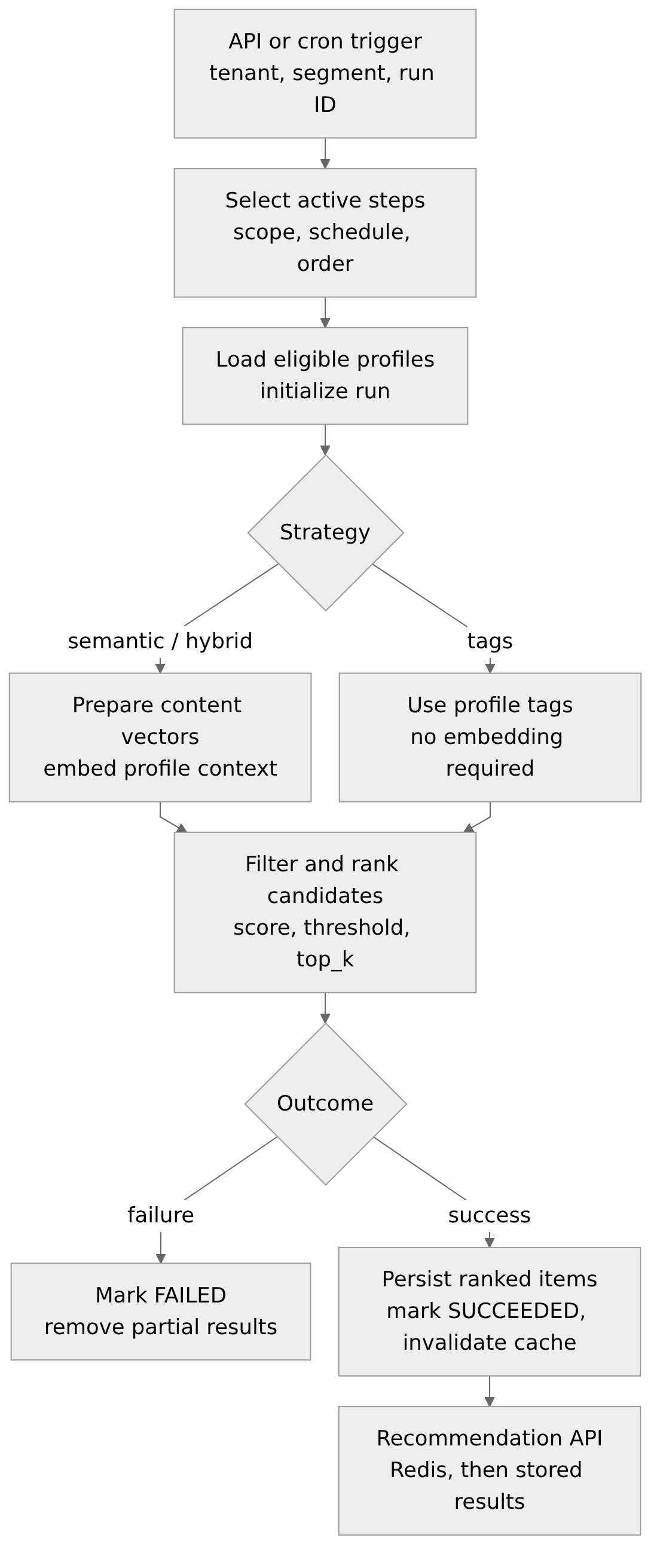 {height=85%}
The following sections describe workflow configuration, ranking behavior,
persistence, and the recommendation read API. Each table name links to its
CREATE TABLE definition in
database-schema.sql.
3. Manual Test Walkthrough
Use this walkthrough to verify the customer-facing flow and the backend execution path. The segment detail view and workflow editor are implemented in segment-details.html and ai-agent-workflow.js.
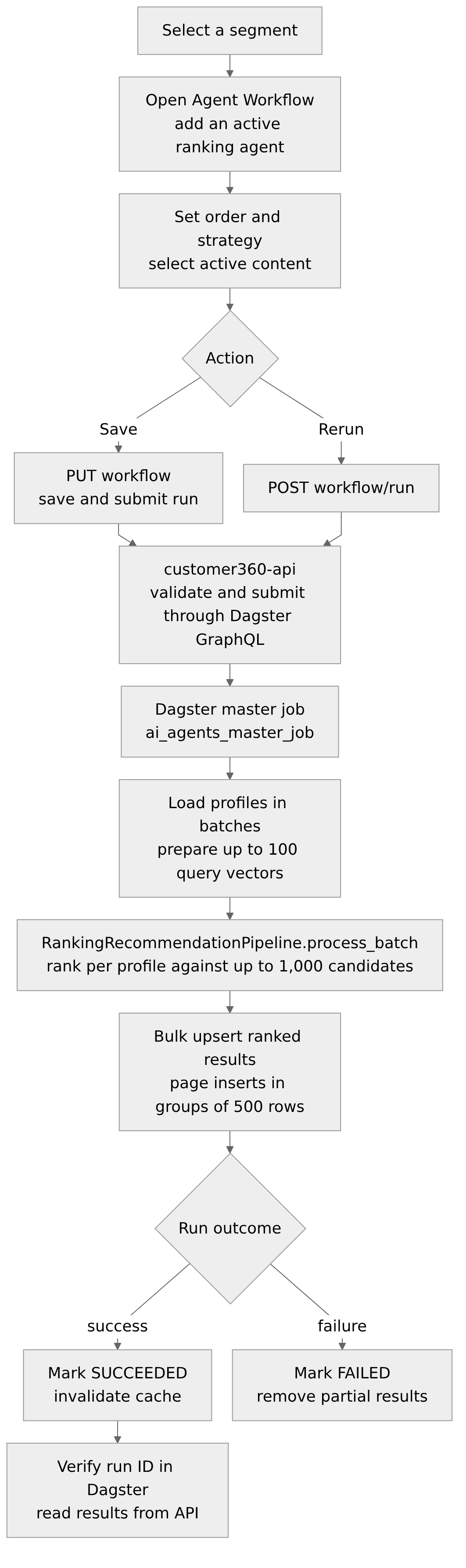 {height=85%}
3.1 Test Procedure
- Confirm prerequisites. Use an active segment with active profiles in the
authenticated tenant. The segment’s
segment_tagmust appear in each test profile’ssegmentation_tags. Confirm that the agent catalog has an active agent withmodel_type = ranking_recommendationand that the tenant has active content items. - Open the workflow editor. In the Segments page, open the target segment’s details, select Agent Workflow, and click Add agent. Choose the active ranking agent, keep the step enabled, and set its execution order.
- Set ranking options and candidates. For an initial smoke test, use
{"strategy": "tags", "top_k": 8}; this does not require an embedding provider. Select at least one active content item or product. Each candidate must belong to the tenant and have domainallor the test profile’s domain. Semantic and hybrid tests also require a supported embedding provider configured to generate 384- or 768-dimensional vectors. - Save once to configure and run. Click Save workflow. The UI sends
PUT /api/v1/segments/{segment_id}/workflowwith the complete orderedstepslist. This is a full replacement of the segment workflow, not a partial update. The API validates and saves the configuration, then submits a Dagster run. The response includesX-Dagster-Run-Id; the UI displays Saved · run queued. Do not also call the run endpoint for the same test unless a second run is intended. - Rerun without editing (optional). To execute a saved workflow again,
call
POST /api/v1/segments/{segment_id}/workflow/runwith the authenticated tenant context and a body such as{"event": {"event_name": "personalization.manual_test"}}. The API returns202 Acceptedwith{"run_id": "...", "status": "submitted"}. A manual API run is not held until the cron schedule; schedule matching applies to cron runs. - Trace execution. The API submits the run asynchronously to Dagster
through
agent_workflow_api.py
and
dagster_client.py.
It does not call the Python ranking handler in the request process. Dagster
starts
ai_agents_master_jobin the backendai_agents_runnerscode location. The runner loads eligible profiles, prepares embeddings when required, and dispatches ranking batches of up to 100 profiles. The pipeline registry dispatchesranking_recommendationto RankingRecommendationPipeline, which applies the tenant, candidate, status, and domain filters before ranking. - Verify the result. Use
run_idto find the run in the Dagster UI.submittedconfirms that Dagster accepted the run; it does not mean the run has completed. After the run succeeds, callGET /api/v1/content-items/recommended?master_profile_id=<profile_uuid>&segment_id=<segment_uuid>&limit=8for an active profile in the segment. The response contains persisted recommendations for eligible items, or an empty list when none are eligible.
If saving returns 503 because Dagster could not accept the run, the workflow
may already be saved; retry with POST /api/v1/segments/{segment_id}/workflow/run.
If ranking fails, inspect the Dagster run and confirm the profile is an active
segment member, candidates are active and tenant-owned, their domains match,
and the selected strategy has the required embedding configuration.
3.2 Automated Unit Tests
Run the ranking handler tests from customer360-backend. The command measures
statement and branch coverage for the handler and fails unless both reach
100%:
PYTHONPATH=.:../customer360-dao/src pytest -q \
  ai_agents_runners/tests/test_ranking_recommendation.py \
  --cov=ai_agents_runners.agent_pipeline.agent_types.ranking_recommendation \
  --cov-branch --cov-report=term-missing --cov-fail-under=100
The test cases are in test_ranking_recommendation.py.
4. Agent Registry: cdp_ai_agents
Agent definitions are global and use agent_code as their stable primary key.
For workflow selection, the runner uses the agent code, model_type, status,
and schedule_definition. Only agents with status = 'ACTIVE' are selected.
The registry also stores model_name, input_features, hyperparameters,
required_variables, system_instructions, and prompt metadata. These fields
are metadata for consumers that need them; the current ranking path does not
pass them to its handler. In particular, model_name does not prove that a
trained artifact is available. Runtime dispatch uses the implementation
registered for the supported model_type.
The database supports ranking_recommendation as the model type used for
content/product ranking. The seeded recommendation agent is
product_recommendation; its current lifecycle status must still be checked
at runtime rather than assumed from seed data.
5. Segment Workflow: cdp_agent_workflow
Workflow rows are tenant-owned and attach one registered agent from cdp_ai_agents to one tenant-owned cdp_segments row under sys_tenant.
| Field | Purpose |
|---|---|
execution_order | Positive, unique position within the tenant/segment workflow; lower values run first. |
is_active | Controls whether the workflow step is eligible to run. |
schedule_definition | Optional five-field cron override; if unset, the agent’s schedule is used for cron runs. |
configuration | JSON object containing strategy-specific settings. |
candidate_content_item_ids | Selected content UUIDs for ranking; the API accepts up to 1,000 unique IDs per step. |
The runner processes active steps in ascending execution_order and ignores
inactive agents. API-triggered runs are immediate; schedule matching is applied
to cron runs.
6. Candidate Selection and Ranking
6.1 Candidate Catalog and Tenant Checks
Candidate IDs refer to
cdp_content_items.
Each row belongs to a tenant and stores its item type (news, video,
product, or article), display and call-to-action fields, segment tags,
status, and publication metadata.
The workflow editor offers candidate selection only for
ranking_recommendation agents. The API validates that each selected ID exists
in the authenticated tenant; the database also enforces tenant ownership and
distinct IDs. An active ranking step must contain at least one candidate. The
runner evaluates only the selected IDs; it does not search the full catalog.
At runtime, candidates must also be active and have domain all or the
profile’s domain.
6.2 Profile Inputs and Configuration
For each profile, the handler requires a non-blank input_data.domain and
accepts input_data.segmentation_tags as a list of non-blank strings (default
[]). Semantic and hybrid strategies also receive a profile embedding and an
embedding model key from the runner. Profile context is built from the domain,
segment tags, and optional semantic_query; it does not contain PII.
| Setting | Default | Validation and behavior |
|---|---|---|
strategy | tags | One of tags, semantic, or hybrid. |
top_k (or limit) | 8 | Integer from 1 to 100; maximum result count. |
minimum_score | 0 | Number from 0 to 1; lower-scoring candidates are excluded. |
semantic_weight | 0.7 | Number from 0 to 1; used by hybrid. |
tag_weight | 0.3 | Number from 0 to 1; used by hybrid. Hybrid weights must sum to more than 0. |
semantic_query | empty | Optional text appended to the profile query; maximum 2,000 characters. |
For semantic, the handler uses semantic weight 1 and tag weight 0. For tags,
it uses tag weight 1 and semantic weight 0. The configured hybrid weights are
normalized when the two scores are combined.
Execution Limits and Batch Behavior
The runner ranks at most 100 profiles per batch. Each batch uses one set-based ranking query and one bulk recommendation upsert; insert statements are paged at 500 rows. Profile-query embeddings are prepared a batch at a time. The runner still loads the segment’s profile IDs, domains, and tags as a list, but does not retain embeddings or ranked results for the full audience.
The workflow accepts up to 1,000 selected content IDs per step, while top_k
remains capped at 100. At 100,000 profiles and 1,000 selected items, one step
can require 1,000 ranking queries and up to 100 million profile-item score
comparisons. Semantic and hybrid scoring also compare each eligible vector at
384 or 768 dimensions. Batching bounds intermediate memory and reduces
per-profile database and embedding overhead; it does not reduce the exact
profile-item scoring work from (O(P \times C)); semantic and hybrid vector
calculations are additionally (O(P \times C \times D)). Actual work is
usually lower after tenant, status, domain, embedding, and selected-ID filters.
Production runtime and provider cost should be benchmarked at the expected
audience size.
6.3 Scoring and Result Ordering
- Tags: the number of matched profile tags divided by the number of profile tags; the score is 0 when the profile has no tags.
- Semantic:
1 - cosine distance / 2, clamped to the range 0–1. - Hybrid: the weighted average of the tag and semantic scores. If the profile has no tags, the handler uses the semantic score when its weight is positive.
Candidates below minimum_score are excluded. Results are sorted by score
descending, publication time descending (null values last), and content ID as
the deterministic tie-breaker. Each result includes a one-based rank, the
strategy scores, matched tags, a reason code, and the content display fields.
Scores are strategy-specific ranking values, not calibrated probabilities.
6.4 Embedding Lifecycle
Semantic and hybrid ranking require the configured DOCS_EMBEDDING_PROVIDER
to be openai or gemini. The runner supports 384- and 768-dimensional
vectors. For selected content, it generates or refreshes a vector when the
canonical text, provider/model, contract version, or dimension is stale.
Migration
the legacy embedding upgrade
preserves legacy 384- and 768-dimensional vectors and clears other sizes.
Products are ranked through their linked content items in the current workflow. Product-table vector columns are reserved for possible future direct product ranking.
6.5 Persistence and Failure Handling
The runner records run status in cdp_profile_recommendation_runs and per-profile ranked items in cdp_profile_recommendations. The read API serves these persisted records; it does not run ranking during the request.
If ranking produces no eligible results, the step fails rather than relaxing
its filters or inventing a fallback. Failure diagnostics distinguish
tenant-missing candidates, inactive content, profile-domain mismatch,
unavailable embeddings, and scores below minimum_score. The error includes
counts at each filter stage and the tenant, segment, agent, and profile
identifiers. The detailed diagnostic query runs only on the failure path and
uses the same tenant and selected candidate IDs.
7. Recommendation Read API
The Customer 360 API exposes the persisted recommendations through:
GET /api/v1/content-items/recommended?master_profile_id=<uuid>&limit=8master_profile_id is required. limit defaults to 8 and must be from 1
through 50. The API derives tenant scope from the authenticated request; a
caller cannot request another tenant’s data. Optional segment_id and
item_type parameters restrict the result set.
For each profile, the API reads the latest successful run for each active segment the profile belongs to. It then merges results across those segments and keeps only the strongest recommendation for duplicate content items. Returned items must still match the profile domain and refer to active workflow, agent, and content records.
A missing or inactive profile returns 404. A valid profile with no eligible
persisted recommendations receives an empty list. Each result includes the
content display fields and matched_tags, segment_id, agent_code, rank,
score, semantic_score, tag_score, strategy, reason, and
generated_at.
The API checks Redis before querying persisted results. Cache keys are scoped
to the tenant, profile, and request filters. Content mutations and successful
recommendation runs invalidate the tenant’s recommendation cache; other
changes become visible within CACHE_TTL_SECONDS. Set CACHE_ENABLED=false
to bypass the cache while debugging.
The route is implemented in content_api.py, and its tenant-scoped query is in content_repository.py.
8. Current and Future Profile Inputs
The current ranking contract reads only:
- the profile’s domain and segmentation tags from cdp_master_profiles;
- segment membership from cdp_segments; and
- explicitly selected content candidates from cdp_content_items.
It does not currently use persona-match records from cdp_customer_personas or shared persona definitions from cdp_persona_archetypes. Additional analytics or persona fields stored on a master profile are also outside the current ranking input contract.
Any future handler that adds these inputs must define tenant-scoped reads and apply relevant consent, suppression, inventory, campaign-eligibility, and domain constraints before returning a recommendation.
9. Data Ownership and Engineering Guardrails
The ranking handler validates its profile inputs and configuration, evaluates only the step’s selected candidates within the step tenant, and returns ranked items. The runner—not the ranking handler—persists per-profile results under the Dagster run ID and updates run status.
The workflow must not:
- read or write data across tenant boundaries;
- rewrite identity links or source events;
- treat an unavailable handler or model as a successful default;
- rank candidates outside the configured, tenant-eligible set;
- send campaigns or notifications directly; or
- overwrite another handler’s output without an explicit ownership contract.
10. Conclusion
The implemented workflow connects tenant-scoped segment configuration to
persisted content rankings that the recommendation API can serve. Its current
contract is limited to active ranking_recommendation steps, explicitly
selected eligible content, and the documented tag, semantic, and hybrid
strategies. Tenant ownership, deterministic ordering, and explicit failure
handling define the operational boundaries of this implementation.