The Customer 360 Model Layer: One Roof, a Small Fleet
Where each AI engine earns its keep across LEO Customer 360
Research note · LEO CDP
leo-customer360· 2026-09-23 Merges and supersedesone-model-across-customer360.mdandsystem-one-models-jev-in-customer360.md.⚠️ Provenance caveat. This paper discusses two engine classes. The LLM layer is running code today. The System One / Jev layer is a proposal whose every performance, cost, and accuracy figure is a single-source vendor claim (TypeSafe.ai, “Introducing System One Models and Jev”) and is marked [unverified]. Nothing about that layer should be adopted before the calibration/latency POC in §7.
Abstract
LEO Customer 360 is not an “AI product” bolted onto a database; it is a
composable CDP whose schema and services were already shaped for models to plug
into. database-init/data-view-for-llm.sql builds materialized views “optimized
for LLM-based text-to-SQL”; customer360.cdp_segments carries a processed_by
flag whose legal values are ('human', 'ai_agent'); customer360.crm_campaign
reserves ai_plan JSONB, strategy_summary, and a vector(1536) embedding
column; customer360-agent/ exposes one unified, provider-agnostic model
endpoint (LiteLLM); and customer360.cdp_ai_agents is a single registry that
seeds every ML / rules / LLM agent as a row.
This paper answers one question: given the engines available to us, where
across the whole platform does each one earn its keep? The thesis has two
moves. First (the original argument): a single foundation model should be a
horizontal reasoning layer — wired once through customer360-agent, reused by
every subsystem — not a feature glued into one screen. Second (the refinement):
that reasoning model is the wrong shape for a large class of fast, typed
decisions the platform also needs, so a System One decision model (Jev)
belongs in a second horizontal seat beside it. The result is three engines under
one roof, mapped to the three primitives the platform already factors its work
into — at the marginal cost of a prompt/schema and a registry row per new job.
1. Framing
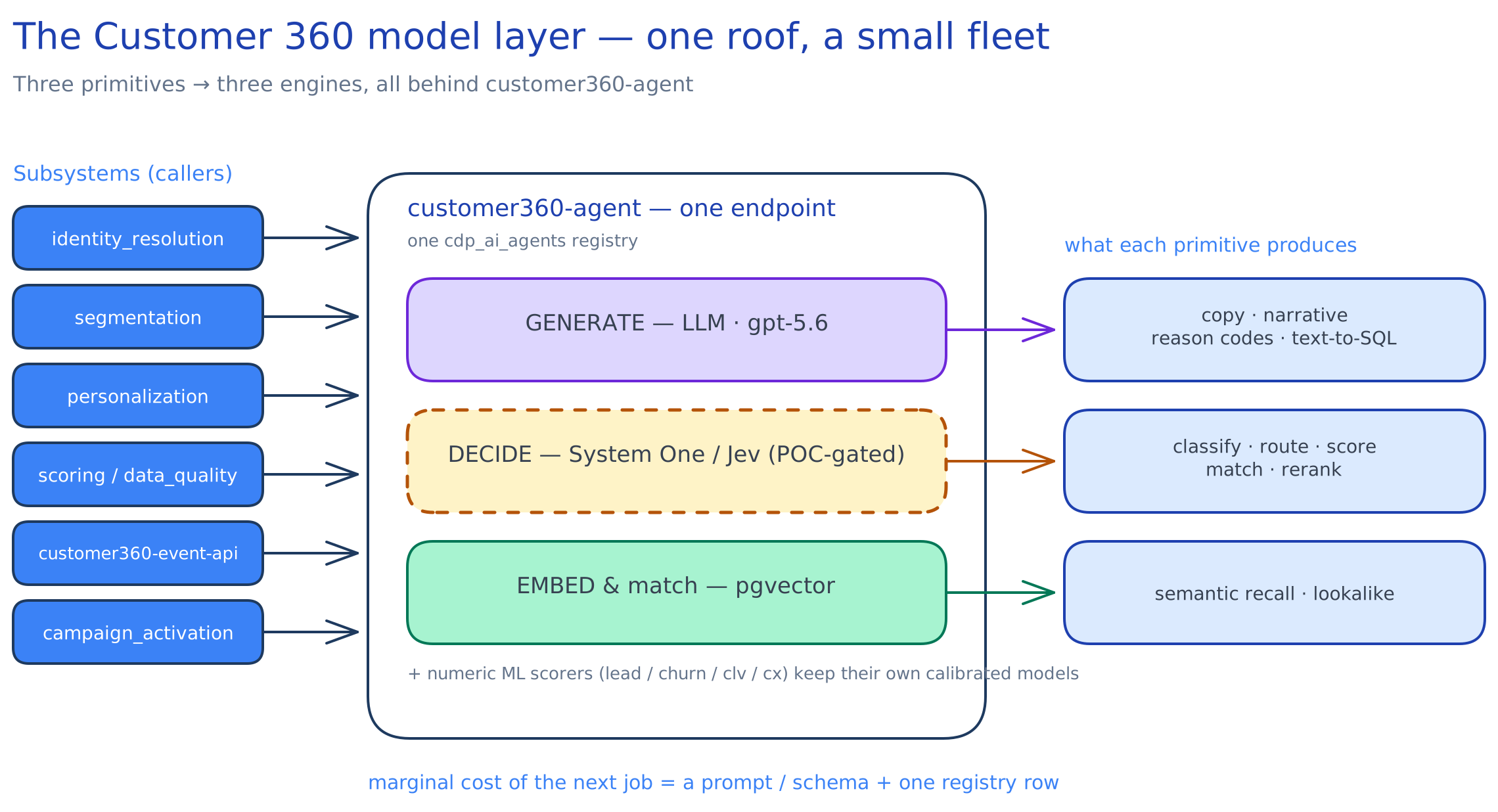
1.1 Three primitives, three engines
Every model-touching use case in the platform is one of three primitives pointed at a different subsystem’s data:
| Primitive | What it does | Engine | Already available? |
|---|---|---|---|
| Generate | Free text out (copy, summaries, narratives, reason codes, SQL) | LLM gpt-5.6 | Yes — campaign_planner/{email,zalo}.py |
| Structure / Decide | Records in → typed decision out (classify, route, score, match, rerank) | System One / Jev (proposed) | Partial — planners emit ai_plan; the rest designed, not wired |
| Embed & match | Text → vector(768/1536) for semantic search | pgvector | Yes — persona_embedding, crm_campaign.embedding, pgvector installed |
Numeric ML scorers (lead/churn/clv/cx) are a fourth family that keeps its
own calibrated models — never swapped for a language model. The whole point:
the marginal cost of the tenth use case is a prompt/schema, not a new model.
1.2 Two reasoning modes
The Generate and Structure/Decide primitives are not the same model in two moods — they are two different classes of model. A chat LLM (“System 2”) deliberates in prose: sequential token generation, string output you parse and validate, seconds of latency, per-token billing. A System One model (“System 1”, Jev) decides in microseconds: parallel sampling, a typed value plus a calibrated confidence, sub-second latency, near-zero output cost. Route by output shape — prose to the LLM, typed decisions to System One.
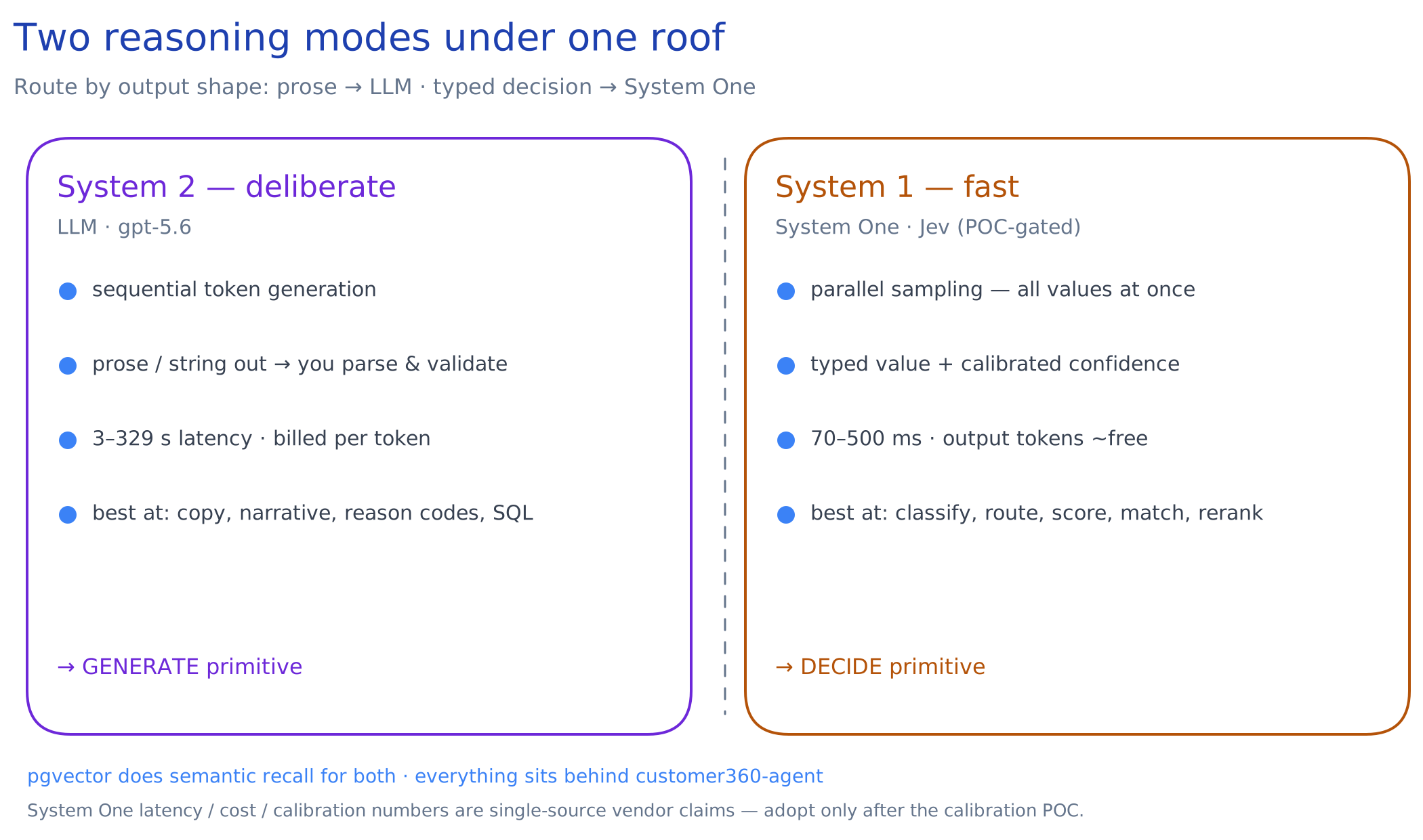
The load-bearing claim for the System One layer is calibration — that a reported confidence of 0.9 really does mean ~90% accuracy. The platform’s guardrails repeatedly need a trustworthy confidence threshold (route low-confidence to a human); today those ride on an LLM’s uncalibrated “I’m 90% sure.” Calibration is exactly what the POC in §7 must prove.
1.3 Subsystem map
The Dagster workspace (customer360-backend/) has eight code locations.
Identity resolution, segmentation, analytics, email, notification, and campaign
activation contain implemented processing. ai_agents_runners provides
tenant-scoped workflow orchestration, while data_synch remains a placeholder;
agent-specific inference handlers are not yet implemented.
flowchart LR
    subgraph Ingest
      RAW[cdp_raw_profiles_stage]
      TRK[customer360-event-api -> S3/MinIO]
    end
    subgraph Core["Core identity + understanding (implemented)"]
      IDR[identity_resolution]
      PER[persona scoring + embeddings]
      SEG[segmentation]
      ANA[analytics MVs]
    end
    subgraph Activate["Activation (mostly placeholder)"]
      CAMP[campaign_activation]
      EMAIL[email_engine]
      NOTIF[notification_engine]
      PZN[personalization]
    end
    MODEL{{"model layer\ncustomer360-agent\n(LLM + System One)"}}

    RAW --> IDR --> PER --> SEG --> CAMP
    TRK --> ANA
    MODEL -. adjudicate .-> IDR
    MODEL -. name + narrate .-> PER
    MODEL -. NL to segment .-> SEG
    MODEL -. text to SQL .-> ANA
    MODEL -. plan + copy .-> CAMP
    MODEL -. personalize .-> EMAIL
    MODEL -. next-best-action .-> PZN
1.4 The registry that makes this literal
customer360.cdp_ai_agents is a single catalog for every model the platform
runs, keyed by a stable agent_code, with a model_type CHECK and the actual
model_name per row. The seed loads the generative and numeric agents today; the
System One layer extends the same table rather than breaking it — add one value
to the model_type CHECK (structured_decision) and each Jev-backed job becomes
a row, exactly like the others. Task agents store their live system_instructions,
required_variables, and an integer instruction_version; prompt history lives
in the customer360-agent prompt store, not Postgres.
flowchart LR
    REG[("customer360.cdp_ai_agents\nmodel_type CHECK += 'structured_decision'")]
    subgraph Gen["generative_llm -> gpt-5.6"]
      PSG[persona_summary_generator]
      CP[campaign_planner]
      ZP[notification_planner]
    end
    subgraph SD["structured_decision -> jev (new)"]
      IA[identity_adjudicator]
      NBA2[nba_reranker]
      EVT2[event_router]
      PII2[pii_classifier]
    end
    subgraph ML["classification / regression -> own models"]
      LS[lead_scoring]
      CS[churn_scoring]
      CLV[clv_scoring]
      CX[cx_scoring]
    end
    REG --> Gen
    REG --> SD
    REG --> ML
Three model_type families, one catalog: gpt-5.6 for generation, jev for
typed decisions, purpose-built numeric models for calibrated scoring. Wiring note:
customer360-agent routes through LiteLLM (chat-shaped); a System One call is a
typed function call, not a chat completion, so it needs a thin dedicated
client alongside LiteLLM — the same shape as the existing packaged agent/DAO
clients.
2. Use cases, grounded per subsystem
Each use case names the real tables/files it reads and writes, the engine it uses, and its status (🟢 built · 🟡 designed, not wired · 🔵 net-new).
2.1 Segmentation — Natural-language → segment (Generate + Decide · 🟡)
The flagship case, because the schema already asks for it. cdp_segments
stores json_rules (QueryBuilder tree), sql_rules, final_generated_sql, and a
processed_by column whose CHECK literally allows 'ai_agent'. The seat is
reserved; nothing sits in it.
- Flow: marketer types “Gen Z shoppers in HCMC who purchased in the last 30
days but didn’t open the last 3 emails.” → the LLM emits a QueryBuilder
json_rulestree → deterministic translator producessql_rules/final_generated_sql→ segmentation job (implemented) computes membership and writessegmentation_tagsontocdp_master_profiles. System One fits the leaf work (classify a field/operator, extract a value with confidence); the full nested tree is sequence-shaped and stays with the LLM. - Guardrail: the model never emits raw SQL that runs. It emits the
json_rulestree; the existing translator produces SQL;tenant_idis injected server-side. Setprocessed_by='ai_agent'so every AI-authored segment is auditable.
flowchart LR
    NL["Marketer intent (free text)"]
    MODEL{{"LLM (Structure)"}}
    TRANS["Deterministic translator\n(existing)"]
    JOB["segmentation job\n(implemented)"]
    subgraph cdp_segments
      JR[json_rules]
      SR[sql_rules]
      FG[final_generated_sql]
      PB["processed_by = 'ai_agent'"]
    end
    MP["cdp_master_profiles.segmentation_tags"]

    NL -. "NL to json_rules" .-> MODEL
    MODEL --> JR
    JR --> TRANS --> SR --> FG
    FG --> JOB --> MP
    MODEL -. "audit flag" .-> PB
2.2 Analytics — Text-to-SQL over the LLM materialized views (Generate · 🟡)
data-view-for-llm.sql already flattens AI/ML scores + behavioral summaries into
mv_customer_transactions (and an engagement MV) with the comment “optimized for
LLM-based text-to-SQL”. The denormalization — the hard part — is done. SQL is
sequential text generation, so this stays on the LLM, not System One.
- Flow: “Average predictive CLV of churn-risk-tier = high customers who bought in Q2?” → LLM → SQL against the MV → execute read-only → LLM narrates the number.
- Guardrails: a dedicated read-only DB role; mandatory
tenant_idpredicate injected after generation; statement timeout; reject anything that isn’t a singleSELECT.
flowchart LR
    Q["Analyst question (free text)"]
    MODEL{{"LLM (Structure then Generate)"}}
    GUARD["Guard: single SELECT +\ntenant_id inject + timeout"]
    MV["mv_customer_transactions\n(+ engagement MV)"]
    RO[("read-only DB role")]
    ANS["Narrated answer + number"]

    Q -. "text to SQL" .-> MODEL
    MODEL --> GUARD --> MV
    MV --- RO
    MV -- rows --> MODEL
    MODEL -. "narrate result" .-> ANS
2.3 Persona — name, summary, and reason codes (Generate · 🟢 + 🔵 extend)
Persona name synthesis and summary generation are already LLM-native; lookalike
discovery already uses the vector(768) persona_embedding. The gap is
explanation, which is pure Generate.
- 🔵 reason codes: the 6-component persona score (
cdp_persona_score_details) is numeric and opaque. Feed the breakdown to the LLM → “High Value / Medium Risk — strong 12-month spend but two recent support escalations.” Store next tocdp_customer_personas. Makes the existing math trustable without changing it. - 🔵 archetype discovery: cluster
persona_embedding, then have the LLM name and describe each cluster to propose newcdp_persona_archetypesrows — human-approved.
flowchart LR
    subgraph Built["🟢 built"]
      SD["cdp_persona_score_details\n(6 components)"]
      EMB["persona_embedding vector(768)"]
    end
    MODEL{{"LLM (Generate)"}}
    subgraph New["🔵 extend"]
      RC["reason code -> cdp_customer_personas"]
      CL["cluster embeddings"]
      ARCH["cdp_persona_archetypes\n(human-approved)"]
    end

    SD -. "explain score" .-> MODEL --> RC
    EMB --> CL -. "name + describe cluster" .-> MODEL --> ARCH
2.4 Campaign activation & messaging — plan, copy, personalize (Generate · 🟢 + 🔵)
campaign_planner/{email,zalo}.py already turns a segment + objective into an
ai_plan and template. crm_campaign holds ai_plan, strategy_summary, approval
columns, and a vector(1536) embedding. The activation/email/notification engines
are placeholders — the output has somewhere to land but nothing lands it yet.
- 🔵 subject/copy variants: generate N variants per campaign for A/B; store as
crm_campaign_content_items. - 🔵 per-persona param fill: Zalo ZNS is template-based. The model doesn’t author
the message — it selects the approved
crm_message_templatesrow and fills params per recipient. Respects the “ZNS is pre-approved templates” constraint exactly. - 🔵 strategy narrative: populate
strategy_summaryso a reviewer reads why before approving (crm_campaign_reviews).
flowchart LR
    SEG["segment + objective"]
    MODEL{{"LLM (Generate + Structure)"}}
    PLAN["campaign_planner/{email,zalo}.py\n(🟢 built)"]
    subgraph crm_campaign
      AP[ai_plan]
      SS[strategy_summary]
      EMB2["embedding vector(1536)"]
    end
    CI["crm_campaign_content_items\n(N variants, 🔵)"]
    ZNS["crm_message_templates\n(params filled per persona, 🔵)"]
    REV["crm_campaign_reviews\n(human approves)"]
    ENG["activation / email / notification\nengines (placeholder)"]

    SEG --> PLAN -. plan .-> MODEL
    MODEL --> AP
    MODEL --> SS --> REV
    MODEL -. "subject/body variants" .-> CI
    MODEL -. "select + fill params" .-> ZNS
    AP --> ENG
    REV --> ENG
2.5 Personalization & next-best-action (Decide · 🔵, best System One fit)
cdp_content_items (news/video/product/article, each tagged with segment_tags +
CTA) and profile/persona embeddings are the two halves of a recommender. The unlock
is latency: at 70–500 ms [unverified] a System One rerank can run
synchronously in the request path (personalize on page load / on event), which a
3–329 s LLM cannot.
- Flow:
pgvectorrecalls candidates cheaply (top-k over the whole catalog); System One reranks and picks the next-best-action (content, channel, timing) with a one-line reason. Lands in thepersonalizationplaceholder job. - Why hybrid: embeddings do cheap recall; the decision model reasons only over the top-k, so cost scales with k, not catalog size.
flowchart LR
    REQ["page load / live event\n(sync request path)"]
    RECALL["pgvector recall\ntop-k candidates"]
    JEV{{"System One / Jev\nrerank + pick\n70-500ms, typed out"}}
    NBA["next-best-action:\ncontent + channel + timing"]
    JOB["personalization job\n(placeholder)"]

    REQ --> RECALL --> JEV --> NBA
    NBA --> JOB
2.6 Identity resolution — gray-zone adjudication + normalization (Decide · 🔵, textbook fit)
Identity resolution is deterministic today (rule predicates → auto-merge or new master). Rules stay in the driver’s seat. Two narrow places benefit from a model — and the adjudication one is the textbook System One case: a pairwise match with a calibrated confidence.
- Gray-zone adjudication: for candidate pairs between auto-merge and
clearly-distinct, System One returns typed
{match, confidence}; the calibratedpdrives the gate — high-confidence pairs become a 1-click recommendation, low-confidence go to a human queue. The LLM writes thereasononly for the cases a human will actually see. The model never silently merges; merges remain reversible viacdp_profile_merge_history. - Field normalization at ingest: Vietnamese name/address variants and transliteration are generative rewriting → LLM, run before the rule predicates so the matcher sees cleaner keys.
flowchart LR
    RULES["deterministic matcher\n(rule predicates)"]
    AUTO["auto-merge / new master"]
    GRAY["gray-zone pair"]
    JEV{{"System One / Jev\ntyped {match, confidence}\ncalibrated p"}}
    REC["p >= hi\nrecommend (1-click confirm)"]
    HQ["lo < p < hi\nhuman queue"]
    LLM{{"LLM (Generate)\nreason for reviewer"}}
    MH["cdp_profile_merge_history\n(reversible)"]

    RULES --> AUTO --> MH
    RULES -- "gray-zone" --> GRAY --> JEV
    JEV -- "high conf" --> REC --> MH
    JEV -- "low conf" --> HQ
    HQ -. "explain only what a human sees" .-> LLM
    HQ --> MH
2.7 Scoring — reason codes and cold-start, not replacement (mixed · 🔵)
cdp_master_profiles carries predictive_clv, churn_probability,
churn_risk_tier, engagement_score. The scorers are registered
(lead/churn/clv/cx), each classification/regression with its own
model_name and a cron schedule — not pointed at a language model. Do not
replace a calibrated numeric model with an LLM. Two legitimate model roles remain:
- Generate — reason codes: the LLM produces a human-readable explanation per
score, and drafts/validates
cdp_scoring_modelsconfigs from a plain-language spec. - Decide — cold-start: a System One model is itself a calibrated decision
model, so before a scorer has enough labeled history to train, Jev can emit a
provisional calibrated score. Once the trained model exists, the
cdp_ai_agentsrow swaps itsmodel_name— a one-row change, not a rewrite.
2.8 Data quality / data_synch (Decide · 🔵, placeholder job)
At ingest, System One can classify a new sys_data_source’s columns —
suggesting source→schema field mappings and flagging likely PII columns —
and the LLM can explain anomalies the analytics job surfaces. Every suggestion is a
proposal a human confirms; never an automatic write to the golden record.
2.9 Governance, review & support (mixed · 🔵, cross-cutting)
- Generate: summarize
sys_audit_logbursts into an incident-style narrative. - Decide: a pre-flight compliance check on message templates — does the copy
risk PII leakage, does the target segment intersect
crm_suppression_list, is channel consent present? System One classifies each check; the LLM drafts the reviewer’s narrative forcrm_campaign_reviews. A human still signs off.
3. Inventory — what exists vs. the opportunity
| Subsystem | Primitive → Engine | Status | Effort to first value |
|---|---|---|---|
| Persona name + summary | Generate → LLM | 🟢 built | — |
| Lookalike (embeddings) | Embed → pgvector | 🟢 built | — |
| Campaign plan + template | Generate → LLM | 🟢 built | — |
| NL → segment | Structure → LLM | 🟡 schema ready | Low (translator + prompt) |
| Text-to-SQL analytics | Generate → LLM | 🟡 MVs ready | Low (read-only role + prompt) |
| Persona / scoring reason codes | Generate → LLM | 🔵 new | Low |
| Campaign copy variants / param fill | Generate → LLM | 🔵 new | Low–Med |
| Content reco / next-best-action | Decide → System One | 🔵 new | Medium |
| Identity gray-zone adjudication | Decide → System One | 🔵 new | Medium |
| Event routing | Decide → System One | 🔵 new | Medium |
| PII / data-quality classification | Decide → System One | 🔵 new | Low–Med |
| Cold-start scoring | Decide → System One | 🔵 new | Medium |
| Field normalization | Generate → LLM | 🔵 new | Medium |
| Governance summaries / compliance | Generate + Decide | 🔵 new | Low |
The two 🟡 rows are the headline for the LLM layer — highest value and lowest effort, because the schema/MV work is done and they wait only on a prompt + a thin translator/guard. The bolded Decide rows are the case for the System One layer — high-frequency, latency- or cost-sensitive, confidence-gated jobs the LLM structurally can’t serve well. Adopting the Decide rows is gated on §7.
4. Guardrails
One shared model layer touching every subsystem concentrates risk. Non-negotiables:
- Tenant isolation is server-side, always. The model may suggest a query or
rule tree;
tenant_idis injected by the API after generation, never trusted from model output. - The model proposes, deterministic code disposes. NL→segment emits a validated
json_rulestree, not runnable SQL. Text-to-SQL runs under a read-only role with a statement timeout and a single-SELECTallow-list. Identity adjudication triages; it never merges. - PII minimization in prompts. Redact/tokenize direct identifiers before they enter a prompt, especially for external providers (LLM or System One). LiteLLM’s provider switch makes “local model for PII-heavy calls” a config, not a rewrite; a self-hosted System One option is strongly preferred for PII-heavy decisions.
- Prompt-injection defense. Profile fields, campaign text, and source data are attacker-influenceable. Treat all record content as untrusted data in a fenced section; never let record text change the instruction. A typed, calibrated answer over poisoned input is still wrong.
- Auditability is already modeled.
cdp_ai_agents.instruction_versionpins the current revision per agent;processed_by='ai_agent',ai_plan, and the review tables give a paper trail for every AI-authored artifact. - Human-in-the-loop on writes to the golden record. Anything that mutates
cdp_master_profiles, activates a segment, or sends a campaign passes an approval gate. Reads and drafts are cheap and safe; writes are gated.
System One additions (because that layer is unproven here):
- All System One numbers are one vendor’s blog — 40–200× speedup,
$0.042/M, “output free”, “zero type errors”, “calibrated” are [unverified] hypotheses to test (§7), not facts to design around. - Wrong tool for generation. SQL, copy, narratives, VN transliteration stay on the LLM. Over-rotating a chat workload onto a decision model is as wrong as the reverse.
- Calibration is domain-specific. Vendor calibration on their eval set is not calibration on our Vietnamese CDP distribution — re-measure a reliability curve on our data before any confidence gate trusts it.
5. Evaluation
| Use case | Metric | How |
|---|---|---|
| NL → segment | Rule-tree correctness | Golden NL→json_rules pairs; executes-to-same-members |
| Text-to-SQL | Execution accuracy | Golden Q→A set over MVs; result-set match, not string match |
| Persona / scoring reason codes | Faithfulness | Do stated reasons match the dominant score components? |
| Campaign plan/copy | Human approval rate | % of ai_plan/drafts approved without edit in crm_campaign_reviews |
| Identity adjudication | Calibration + P/R | ECE/reliability on labeled gray-zone; precision/recall at the gate |
| Content reco | Engagement lift | A/B vs. rules-only recommendations via tracking events |
Because everything routes through customer360-agent, evaluation is centralized:
log (engine, prompt/instruction_version, inputs, output, confidence, latency_ms, downstream outcome) once and it covers every use case.
6. Recommended sequence
Track A — the LLM layer (ship now; schema is ready):
- NL → segment and text-to-SQL analytics — schema + MVs ready; ship a translator + read-only role + versioned prompt. Highest value/effort ratio in the platform.
- Reason codes for persona and scoring — pure Generate, no new writes, immediately makes existing numbers trustable.
- Campaign copy variants + per-persona param fill — extends the working planner into the placeholder engines.
Track B — the System One layer (behind the §7 gate):
- Identity gray-zone adjudication POC — labels come free from
cdp_profile_merge_history+ the review queue; fully human-gated. Proves (or kills) the calibration claim before anything real-time depends on it. - Real-time next-best-action — the latency killer-app; fills the
personalizationjob. - Event routing + PII / data-quality classification — the high-volume, output-free-cost story.
- Cold-start scoring fallback — Jev scores until a numeric model is trained,
then the registry row swaps
model_name.
7. The System One gate (do this before adopting Track B)
Every latency/cost/accuracy/calibration figure for System One is a single-source vendor claim. Run one POC with existing ground truth — identity gray-zone adjudication — and let it decide the whole layer.
| Question | Metric | Method |
|---|---|---|
| Is it actually calibrated on our data? | ECE / reliability diagram | Score a labeled gray-zone set; bin predicted p vs observed accuracy |
| Fast enough for the request path? | Latency p50 / p95 | End-to-end from customer360-agent, warm and cold |
| Cheaper than the LLM path? | Cost / 1k decisions | vs the current LLM structured call on the same batch |
| Good enough at the gate? | Precision / recall at chosen hi/lo | vs human labels, on the gray-zone slice only |
Adoption gate: proceed only if calibration holds (low ECE) and latency + cost beat the LLM by the margin the real-time cases need. If calibration fails, the “trust the confidence” premise collapses and we keep the LLM — the POC is designed to find that out cheaply.
8. Conclusion
The most useful thing the model layer can do for LEO Customer 360 is not a new
feature — it is to become a shared horizontal capability the platform was already
built to accept. The schema reserved the seats (processed_by='ai_agent',
ai_plan, LLM-optimized MVs, embedding columns, the cdp_ai_agents registry), and
customer360-agent provides the single, provider-agnostic endpoint. Map the three
primitives to three engines — Generate → LLM gpt-5.6, Structure/Decide →
System One (jev), Embed & match → pgvector — with numeric scorers keeping
their own models, all behind one endpoint and one catalog.
The LLM layer is ready to ship: prompts, thin deterministic translators, and guardrails, not model research. The System One layer is a conditional bet — it buys sub-second latency, near-zero output cost, and calibrated confidence the chat model structurally can’t, but on vendor claims we haven’t verified. So the contribution is testable: wire the adapter, register the agent, run the identity-adjudication calibration POC. If it holds, Customer 360 gains a fast, typed decision layer beside its reasoning model at the marginal cost of a schema and a row. If it doesn’t, we learned that for the price of one POC and kept the LLM. Either way, the architecture — one endpoint, one registry, primitive-shaped use cases — is exactly what makes running a small fleet of models cheap.